Picture this: a batch of 2,000 units leaves a factory in China, spends three weeks on the water, and arrives at your FBA warehouse or your customer’s door.
You open the first carton. A third of the products have surface scratches. The charging ports are tight on some units, loose on others. The barcodes on two outer cartons won’t scan.
All you have from the factory is a set of photos sent before shipment: pristine products, neatly stacked cartons, a stamped “passed” inspection sheet.
The gap is in the part you never saw. The photos are real, but they show hand-picked samples. The bulk shipment is real too, it’s just that nobody looked at it on your behalf.
That is exactly what QC inspection in China is for. A day of product inspection at the factory typically costs a few hundred dollars. A failed batch costs the goods, the freight, your platform performance score, and your reviews. This guide publishes the full 15-point quality control checklist we use ourselves, explains when to book DUPRO vs FRI, how to read an AQL report, and what to do when inspection finds problems.
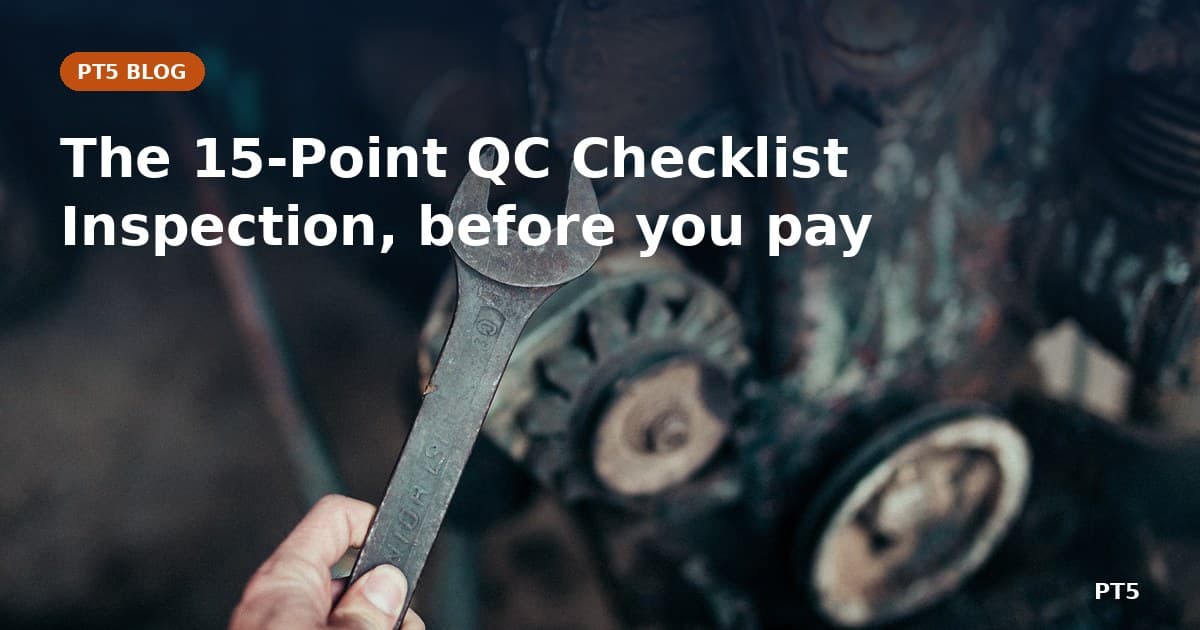
Photo: Shixart1985 / CC BY 2.0 / via Wikimedia Commons. Cropped and resized.
Why inspection matters when you source from China
1. There is a gap between the listing photos and the bulk goods
The samples the factory sends, the photos on the listing, the products you see on a video call are usually picked for the purpose. The bulk run is made by a different shift, on a different machine, on a different day. Color drift on plastic parts, shifted silk-screen printing, flash on molded edges, you only see these in the bulk.
2. Batch variation is normal, not exceptional
The same supplier can run a perfect batch and then a weak one: a new raw material lot, a night shift rushing the deadline, three compressed production days. If nobody inspects, your customers’ negative reviews are doing the factory’s quality control for you.
3. If you are not on site, you have no evidence
Find the problem after the goods land overseas and your negotiating position is zero. The factory can blame freight damage or improper storage. A photo report produced on site, before the goods leave the factory, is your only leverage for rework, replacement, or a price deduction.
4. Small sellers are the most exposed
Large sellers have sourcing teams and returns buffers. For a small seller, one batch can be most of the working capital, and one quality incident can stall the store. Inspection is insurance for a big seller. For a small one, it is survival.
The three inspection timings: DUPRO, FRI, and full inspection

| Type | When it happens | What gets checked | Best for |
|---|---|---|---|
| DUPRO (during production) | When roughly 20% of the order is made | First finished units against the approved sample, line workmanship, early defects | First orders, custom/private-mold products, high-value goods, factories with a history |
| FRI (final random inspection) | When 80–100% is finished and packed | AQL sampling of finished goods plus packaging, labels, and quantity | The standard choice for most repeat orders and standard products |
| Full inspection | Before packing, or at the warehouse | Every single unit checked, 100% | High-value or high-risk categories (children’s products, electronics, medical-adjacent), or sorting after a failed FRI |
How to choose:
- First order with custom goods: book both DUPRO and FRI. A problem caught mid-production costs a line adjustment. The same problem found after packing means reworking the whole batch.
- Repeat order, standard product, clean factory record: a single FRI is usually enough.
- High-value or safety-sensitive category: FRI alone is not enough; go straight to full inspection, or switch to full sorting if the FRI shows excess major defects.
- Loading supervision is a separate option: the inspector watches the container loaded, photographs the seal and seal number, and prevents substitution or short loading. Worth it for full-container orders.
The 15-point QC checklist (published in full)

The checklist is organized in five groups. Each point says what to check and what counts as a fail.
A. Product & Appearance
- Appearance — scratches, stains, sink marks, flash, molding defects, shifted or blurry silk-screen printing. Compare each sampled unit against the approved sample.
- Function — power, switches, charging, pairing, buttons, app connection: every function point is actually tested, not just “it switches on.” Electronics are tested on a sample ratio, with the most common real-use actions.
- Color consistency — check units against the signed sample or Pantone card, unit to unit and batch to batch. The color approved on a screen and the color that comes out of printing or injection molding are two different things.
B. Durability & Safety
- Safety — sharp edges and points, loose small parts (a choking hazard on children’s products), electrical safety, abnormal heat or leakage. Where a certification mark is required, check it is actually printed where it should be.
- Aging and durability — simulated use by category: repeated opening/inserting/folding dozens of times, seam pull, button life, zipper smoothness. (Optional: performed based on product category and client request; tell us the product type when booking so we can confirm whether it applies.)
- Odor — chemical smells from plastic, glue, or textiles. Odor drives a large share of return reasons, and it cannot be photographed. Someone has to be there to smell it. (Optional: performed based on product category and client request; tell us the product type when booking so we can confirm whether it applies.)
C. Packaging & Labels
- Packaging — outer cartons intact with no moisture damage or deformation; inner protection and cushioning adequate; packaging method matches what was approved.
- Drop test — a one-corner, three-edge, six-face drop from the standard height, then open and check the product. (Optional: performed based on product category and client request; tell us the product type when booking so we can confirm whether it applies.)
- Labels — product labels, country-of-origin marking (Made in China), warning text, age grading, and FBA-required FNSKU and carton labels, all in the right place with the right content.
- Barcodes — UPC/EAN/FNSKU scanned batch by batch: they must scan and the result must match. Blurry, duplicated, or mismatched codes are flagged on the spot.
D. Quantity & Documents
- Quantity — total cartons, units per carton, and the loose end-carton counted against the packing list. Short shipments and mixed models are not rare at smaller factories.
- Accessories — manuals, accessory packs, cables, gifts, warranty cards: complete counts and the correct versions (this matters in multilingual markets).
- Certification verification — CE, FCC, RoHS, CPC and similar documents checked as originals or copies: the certificate is genuine, the holder matches the factory, and the covered model list includes your product. A photo of a certificate does not mean that certificate covers your goods.
E. Logistics Fit
- Dimensions — actual length, width, and height of product and packaging measured against the spec sheet. One centimeter off can change FBA chargeable weight or the warehouse shelf slot.
- Weight — unit weight and carton weight measured. It drives freight quotes, FBA inbound limits, and the weight-related shipping surcharges we covered in our packaging guide.
Quick logic: group A decides whether the customer can use the product, group B decides whether it causes harm or returns, group C decides whether it can be received and shelved, group D decides whether the money and the goods match, group E decides whether the freight bill blows the budget.
Quick-reference table: the 15 points
| # | Check point | What we check | What counts as a fail |
|---|---|---|---|
| 1 | Appearance | Surfaces, printing, molding vs the approved sample | Scratches, stains, flash, sink marks, shifted or blurry print |
| 2 | Function | Power/charging/pairing/buttons/app, all functions tested | Any dead function, poor contact, “powers on” only |
| 3 | Color | Units vs signed sample/Pantone, unit to unit and batch to batch | Color outside acceptable tolerance, clearly off the sample |
| 4 | Safety | Sharp edges, small parts, electricals, heat, certification marks | Sharp points, detachable small parts, leakage or abnormal heat, missing marks |
| 5 | Aging/durability | Simulated use: folding, insertion, pull, button life (optional) | Loosening, cracking, or function loss after simulated use |
| 6 | Odor | On-site smell check of plastic/glue/textiles (optional) | Pungent chemical smell, clearly different from the approved sample |
| 7 | Packaging | Outer cartons, inner packaging, cushioning | Damaged or damp cartons, weak protection, method not as agreed |
| 8 | Drop test | One-corner, three-edge, six-face drop (optional) | Product damage or function loss after the drop |
| 9 | Labels | Origin marks, warnings, age grading, FNSKU/carton labels | Missing or wrong labels, position/content failing inbound rules |
| 10 | Barcodes | UPC/EAN/FNSKU scanned batch by batch | Won’t scan, duplicated or wrong codes, system mismatch |
| 11 | Quantity | Carton count, units per carton, loose carton vs packing list | Short shipment, mixed models, count mismatch |
| 12 | Accessories | Manuals, cables, packs, gifts, warranty cards | Missing items, wrong version, wrong language |
| 13 | Certifications | CE/FCC/RoHS/CPC authenticity and covered models | Fake certs, holder mismatch, model not covered |
| 14 | Dimensions | Product and packaging measured | Outside spec tolerance, affecting charges or shelving |
| 15 | Weight | Unit and carton weight measured | Large deviation from declared weight, triggering freight re-rate |
AQL explained: sampling standards and how to read the report

AQL (Acceptable Quality Limit) is the internationally used sampling standard for inspection (ISO 2859-1, the US ANSI/ASQ Z1.4 standard is the same table). You do not need to memorize the whole table. Three concepts matter.
1. Sample size follows the batch size; the usual inspection level is General II
For a batch of 501–1,200 units, the standard sample is 80 units. For 1,201–3,200 units, it is 125. The inspector draws units randomly across cartons, not from whatever the factory hands over.
2. Defects come in three classes, each with its own tolerance
- Critical: safety hazards, regulatory violations, units that cannot be used at all. Usually limited at AQL 0.65; if you want it stricter, zero tolerance can be agreed in advance (one critical defect means FAIL).
- Major: defects that affect use or are obvious on appearance, the kind customers return or complain about. Commonly set at AQL 2.5.
- Minor: small flaws that do not affect use. Commonly set at AQL 4.0.
3. The verdict uses Ac/Re (accept/reject numbers)
Take a sample of 80 units at AQL 2.5: up to 5 major defects and the batch passes; 6 or more and it is rejected. Report verdicts read PASS, HOLD (conditional, awaiting your decision), or FAIL.
What an inspection report contains: a usable report includes the sampling details (batch size, sample size, location, date), photographs of each defect category (close-up of the defect plus the whole unit with its row number), the quantity count, the AQL tally, the verdict, and the inspector’s signature. Within 24 hours of the inspection being completed, the photo-and-text report lands directly in your WhatsApp group: which carton, what problem, how many units, all in writing.
The key thing to understand: AQL is a probability tool, not a zero-defect guarantee. A clean sample of 80 does not mean the remaining units are perfect. It turns “is this batch above the agreed quality level” into a defensible yes/no verdict. If you need certainty on high-value goods, use full inspection.
When inspection finds problems: on-site handling and the evidence chain

Photo: QmcBeQ3G7DZCmY84uPgT / CC BY 4.0 / via Wikimedia Commons. Cropped and resized.
Half the value of inspection is finding problems. The other half is finding them while the goods are still in the factory.
- Hold the goods. Once the report is out, the goods are at the factory and the balance payment has not been made (or your agent is still holding it). You hold all the leverage.
- Match the action to the defect level:
- Minor, low proportion: the factory reworks or sorts on site, at the factory’s cost.
- Major defects over the limit: the batch is reworked or sorted, and only released after re-check passes.
- Critical defects or defects that cannot be reworked (wrong version, wrong material, a fake certificate): reject, demand replacement or a price deduction, and switch factories if necessary.
- Keep the evidence chain complete. The inspection report, defect photos and video, and the quantity record are the entire basis for negotiating with the factory. This is where supplier negotiation skill meets reality: without on-site evidence, every deduction conversation is just asking for a favor.
- Passed goods go to the agent’s warehouse. Inspected and approved stock moves straight into our warehouse for free storage and per-order fulfillment, so you are not paying for overseas storage on stock that has not sold yet.
How PT5 handles QC: four layers, priced transparently
Four layers, picked as needed, never bundled:
| Layer | What we do | Fee | Best for |
|---|---|---|---|
| Sample comparison | Pre-order sample comparison (up to 10 suppliers, up to 5 kg total) | $20 per session + sample purchase and shipping costs | Product and supplier selection |
| Routine warehouse check | Default check on every order in and out: appearance, quantity, basic function, with photos and a weight record | Free, included with every order | All dropshipping orders |
| On-demand warehouse inspection | AQL sampling or 100% full inspection at our warehouse | $20 per hour (based on per-unit inspection time × quantity) | High-value goods, first orders with new suppliers, sorting after an FRI |
| Factory inspection | Inspector on site at the factory: DUPRO, FRI, full inspection, or loading supervision, to AQL standard, with photo and video reports | $150–250 per person-day | Large volumes, first orders, high-risk categories |
Reports are photo and video throughout, delivered to your WhatsApp group within 24 hours of inspection completion. Inspected goods move straight into our warehouse for free storage and per-order fulfillment, and any issues are driven to resolution inside the WhatsApp group.
FAQ
Is inspection worth it for small batches?
Do the math: the inspection fee versus the batch value, plus outbound freight, plus your account standing. For test orders worth a few hundred dollars or less, the routine warehouse check plus sample comparison is usually enough. Once a single batch passes roughly a thousand dollars, or it is custom or private-mold stock, it is hard to construct a scenario where an FRI is not worth it.
Can I just ask the factory to film a video?
It helps as a supplement, but a factory-made video is not independent evidence: the factory decides what the camera sees and what it does not. The value of inspection is precisely the viewpoint that does not report to the factory.
Can goods bought on 1688 be inspected too?
Yes. Goods routed through an agent can have the on-demand warehouse check added at intake ($20 per hour). Inspecting a bulk order directly at the factory requires the agent to schedule the visit with the factory, which is why factory inspection is normally arranged through an agent.
What matters extra for FBA-bound goods?
Groups C and E carry the weight: FNSKU labels, carton labels, scannable barcodes, packaging that meets Amazon inbound requirements, and actual weights and dimensions. An inbound rejection caused by a label error costs far more than the inspection.
How far in advance should I book inspection?
Booking several working days ahead is safest, so the factory can have the goods at the agreed inspection stage (DUPRO needs about 20% of units finished; FRI needs packing done). In the main production regions an same-week slot can occasionally open when schedules allow, but never push inspection into the last day before shipment: if a problem is found, there is no time left to fix it.
Get inspection before the goods move
Before a bulk order ships, put a pair of eyes on the factory floor on your behalf.
Send the product link and order quantity over WhatsApp. We will tell you which checkpoints apply to your product type, whether DUPRO or FRI fits, roughly how many hours or person-days it takes, and the total cost: transparent per-day or per-hour pricing, with you deciding whether to inspect and how much.
Related Articles
- 1688 vs Taobao vs AliExpress (2026): Where to Source from China
- Custom Packaging for Dropshipping (2026): From Generic to Premium
- How to Negotiate with Chinese Suppliers: 7 Scripts That Actually Work
Have your say
Have you ever received a batch that looked nothing like the samples? Which checkpoint has saved you the most money? Tell us in the comments below.
Sources
- ISO 2859-1 / ANSI/ASQ Z1.4 sampling procedures for inspection by attributes — the public source for AQL sample sizes, inspection levels, and accept/reject numbers used in this guide.
- PT5 internal QC operating procedures and inspection reports — the 15-point checklist, the four service layers, and pricing (pricing source archived in company/ quality-control feature documentation, confirmed by the business).

Comments
Have your say. Share practical experience, point out something we missed, or ask a follow-up question.
Loading comments...
Join the conversation
Log in with your PT5 account to comment or vote.
Log in to commentNew to PT5? Create an account