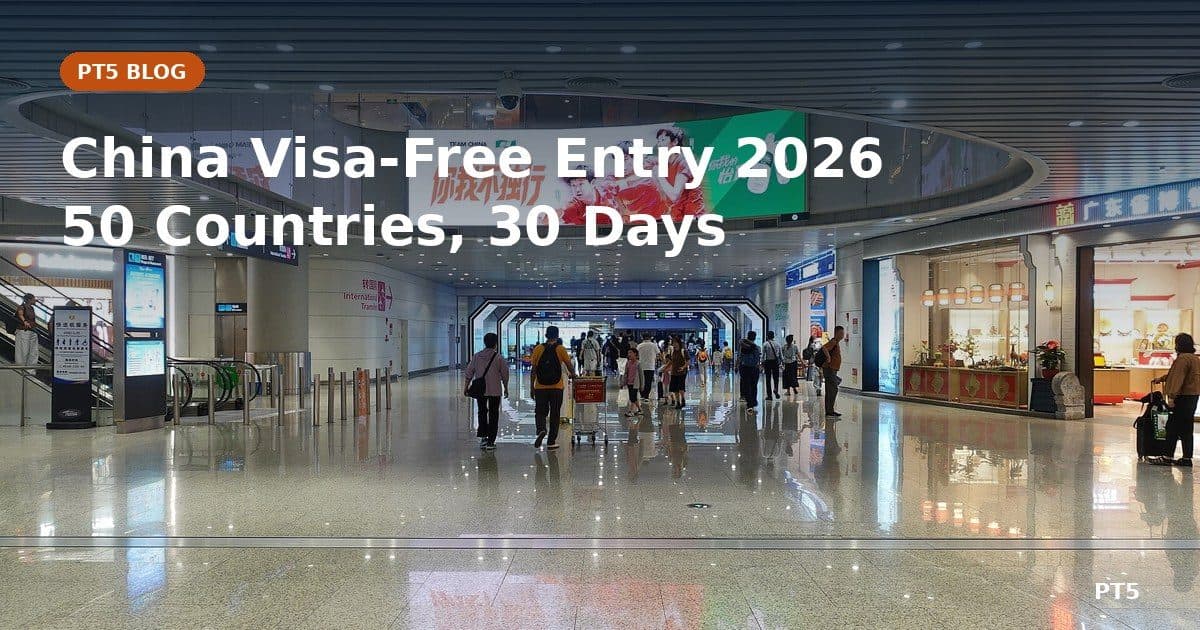
Cover photo: 颐园居, CC BY-SA 4.0, via Wikimedia Commons. Cropped and resized; adapted image shared under the same licence.
You have compared 1688 listings, collected a dozen supplier quotes, sat through endless video calls, and you still cannot tell whether the factory floor matches the brochure. A screen will not settle that question; you have to go and see. For years, “going” meant a visa: paperwork, fees, a wait measured in weeks. Plenty of buyers stalled at that step and never booked the flight.
In 2026 the barrier is largely gone. Buyers from 50 countries can enter China visa-free and stay up to 30 days for business, tourism, family visits, exchange activities or transit, on an ordinary passport (National Immigration Administration; Consular Service Network, Sources [1][2]). If your country is not on that list, the 240-hour transit visa-free policy (57 countries) or a regional scheme such as Hainan may still get you in (Sources [3][4]).
This article is not a translation of the policy documents. It is the briefing we hand a buyer: who qualifies, what to carry, how the 30 days are counted, what to sort out on the first night after landing, and how to lay out a seven-day trip that combines factory visits, a trade fair and goods inspection.
One boundary before anything else: PT5 does not provide visa consultation or visa application services. Visa rules belong to China’s National Immigration Administration and its embassies and consulates abroad; every figure in this article is as of September 2026, so re-check the official pages before you book. What PT5 handles starts after you land: airport pickup, an escort on the ground, translation, and making sure those 30 days end in decisions you trust.
Policy at a Glance: Three Routes
China’s visa-free arrangements for foreign visitors in 2026 come down to three routes.
Route 1: unilateral visa-free entry (50 countries, up to 30 days per visit). Thirty-five European countries, seven Asian, six from the Americas, two Oceanian; the full list is in the next section. Permitted purposes: business, tourism, visiting family or friends, exchange activities and transit. Business is explicitly included, which covers factory visits, trade fairs, inspection and negotiations. You may depart from any country or region outside China and enter through any open port: air, land or sea (Source [2]).
Route 2: 240-hour transit visa-free (57 countries, up to 10 days). You hold a confirmed onward ticket to a third country or region and enter through one of 65 approved ports, including Beijing and Shanghai. As of August 20, 2026 the list stands at 57 countries, with Kyrgyzstan and Vietnam the latest additions (Sources [3][4]). The keyword is transit. USA to China to Thailand works. USA to China and back to the USA does not: the onward destination must be a third country or region, not the country you came from.
Route 3: regional schemes. Hainan’s 30-day visa-free entry covers 61 countries as of August 20, 2026 (enter through Hainan ports, travel on the island only). Smaller schemes exist too: 144-hour group entry for tourists from Hong Kong (SAR) and Macau into the Pearl River Delta, and 15-day entry for international cruise groups via Shanghai (Sources [3][4]). Separately, more than a dozen countries (Singapore, Thailand, Malaysia, the UAE and Kazakhstan among them) hold mutual visa-waiver agreements with China, normally 30 days, under the treaty track rather than the unilateral one.
For a sourcing trip the decision tree is short. On the 50 list: take Route 1, with 30 days nationwide and no onward-ticket requirement. Not on the 50 list but on the 57-country transit list: take Route 2 and build the trip around a connecting ticket through China. On neither list: check the mutual-exemption countries, or go the traditional route with a China business travel visa (the M visa).
A note for US buyers, because it matters commercially: the United States is not on the 50-country list, but it is on the 57-country transit list. If you fly from the US, set your onward leg to Hong Kong (SAR), Japan or Bangkok, and the 240-hour channel puts you legally on the mainland for a compact factory trip under ten days. Keep that in mind; the itinerary later in this article works for both routes.
The 50-Country List and Time Limits
Europe (35): France, Germany, Italy, the Netherlands, Spain, Switzerland, Ireland, Hungary, Austria, Belgium, Luxembourg, Poland, Slovenia, Portugal, Greece, Cyprus, Slovakia, Norway, Finland, Denmark, Iceland, Andorra, Monaco, Liechtenstein, Bulgaria, Romania, Croatia, Montenegro, North Macedonia, Malta, Estonia, Latvia, Russia, Sweden, the United Kingdom.
Asia (7): Brunei, South Korea, Japan, Saudi Arabia, Oman, Kuwait, Bahrain.
Americas (6): Brazil, Argentina, Chile, Peru, Uruguay, Canada.
Oceania (2): Australia, New Zealand.
(List source: National Immigration Administration, compiled from Ministry of Foreign Affairs announcements, Source [1].)
How long each policy runs:
| Group | Visa-free entry valid until |
|---|---|
| Brunei | No end date announced |
| Russia | December 31, 2027 |
| The other 48 countries on the list | December 31, 2026 |
(Source: Consular Service Network FAQ, updated 2026-07-21, Source [2]; the Chinese Embassy in Canada’s “Unilateral Visa Exemption” page, updated May 2026, lists every country’s term, Source [5].)
Policy limits as announced on 2026-07-21 (Consular Service Network FAQ). Earlier embassy pages showed different expiry dates, so reconfirm before booking flights.
Three details that change how you plan:
The 30 days count from the day after entry. You get 30 calendar days starting the day after you clear immigration (Source [2]). Land on October 1 and you can stay through October 31. Work backward from “arrival plus 30” when you book the return flight, and leave a day of margin.
Multiple entries are allowed. The official FAQ says you may use visa-free entry repeatedly, and there is currently no cap on the number of entries or on total days (Source [2]). A buyer can fly in once a month for inspections; each visit restarts the 30-day clock. The only condition is that each visit’s activities match the declared purpose.
Need more than 30 days? Reset the clock with a real trip out. When a project runs past 30 days, the clean route is a short trip to a nearby destination, then a fresh visa-free entry on the way back. Hong Kong, Japan, South Korea and Taiwan are each a short flight from Guangzhou or Shenzhen, and each is easy for most of the 50 nationalities: Hong Kong grants 90 days (180 for British passport holders), Japan 90 days, Taiwan 90 days for around 65 nationalities (with its online arrival card), and South Korea 90 days with a temporary K-ETA waiver through 2026 (Sources [9][10][11][12]). From mainland China, the Taiwan route runs on the regular cross-strait flights; foreign passport holders clear exit formalities as usual, and Taiwan sets the entry rules on its side. The official FAQ puts no cap on the number of entries or on total days (Source [2]), so the day after a new entry starts a fresh 30-day stay.
Two cautions. First, do not turn this into a border sprint: immigration officers decide every entry, and repeated same-day turnarounds invite questions about purpose, funds and onward travel. Book a night, see a real market or supplier, take the break – a short working trip is what the allowance is for. Second, rules move: confirm the current destination rules, flight routes and official entry lists before you book.
Where you start from does not matter. You can depart from any country or region outside China: from home, from a business trip in a third country, from a holiday (Source [2]).

Entry Checklist
Visa-free entry is granted after an inspection by border officers. It is not an automatic stamp. Here is what the official guidance expects you to hold:
Required:
- A valid ordinary passport. Its validity must cover your stay; airlines in practice ask for six months or more and blank visa pages, so plan to that standard. Travel documents, temporary papers and emergency documents do not qualify (Source [2]).
Strongly recommended, since border officers use these to verify your purpose:
- A return or onward ticket booking
- A hotel booking or other proof of accommodation
- Documents that match your stated purpose: an invitation letter from the party you are visiting (supplier, fair organizer, partner). For a sourcing trip, a supplier list with appointment confirmations does the job.
The purpose red line: work, study and journalistic reporting are not covered by visa-free entry, and “short-term” does not change that (Source [2]). Fairs, factory visits, negotiations and inspection are fine; they fall under business. Taking up employment in China on visa-free entry is not. Participants in sports events, exhibitions and study tours are explicitly covered within the 30 days.
The rules are the same for minors as for adults, and both independent travelers and tour groups qualify (Source [2]).
If 30 days will not be enough: do not overstay. For legitimate reasons arising after entry, apply to the exit-entry administration of the local public security organ for a stay permit. If you know before departure that you will exceed 30 days, apply for the matching visa first (Source [2]).

Unilateral Visa-Free vs 240-Hour Transit
The unilateral 30-day policy and the 240-hour transit visa-free route get mixed up constantly. Side by side:
| Item | Unilateral visa-free | 240-hour transit |
|---|---|---|
| Countries | 50 | 57 (the US is on it; Kyrgyzstan and Vietnam added 2026-08-20) |
| Maximum stay per entry | 30 calendar days | 240 hours (10 days) |
| Onward ticket | No hard requirement (carry one anyway) | Mandatory: confirmed connecting ticket to a third country or region |
| Where you can go | Nationwide | The allowed areas around the 65 ports (24 provinces and regions), cross-province travel permitted |
| Purpose | Business, tourism, family visits, exchange, transit | Transit (tourism, business and visits allowed during the stay) |
| Hard limit | No activities beyond the stated purpose | The onward destination must not be your origin country |
| Best for | Routine sourcing trips from the 50 countries | Buyers not on the 50 list, US buyers above all |
(Sources: NIA announcements and FAQ; Consular Service Network FAQ, Sources [2][3][4].)
How to choose. On the 50 list: take the unilateral route, no contest: 30 days nationwide beats 10 days of transit every time. Not on it (the US, Mexico and others): the 240-hour channel is the most cost-effective legal path. One “US to China to a third country” ticket, ten days, one compact factory trip. Watch the exit clock: the 240 hours count from midnight after the day of entry, so the onward flight has to land inside the window.

First Night: Registration, Payments, Connectivity

Visa-free entry answers “can I come in.” How well the trip runs depends on three small things you handle right after landing.
Accommodation registration, which is a legal requirement. Hotels register their guests automatically at check-in. If you stay anywhere else (a short-term apartment, a friend’s place), you or your host must register with the local public security bureau within 24 hours of arrival (Exit and Entry Administration Law, Article 39). Hotels are the low-friction option, and the registration slip is worth keeping for reference.
Payments. Daily life in China runs on QR codes. Swiping a Visa or Mastercard works far less often than it does at home. Before you fly, link your international credit card to Alipay or WeChat Pay, both of which accept foreign cards, and taxis, restaurants, convenience stores and market stalls all become a scan. Large payments to factories are a separate matter: those go through proper banking channels, not a personal QR code.
Connectivity. Whether your usual apps work on mainland networks varies by app and by week, so here is the practical version: arrange an eSIM or a roaming plan before departure so you are online the moment you clear customs, then use that connection to finish the payment setup and download offline maps. This first-hour setup (eSIM, payments, offline maps) is exactly what the Digital Survival Kits are built for; what they include comes in the landing-support section below.
A 7-Day Sourcing Itinerary Inside the Window
This is the part worth copying. Which countries can visit China without a visa is on every news site; how to spend the window once you land is not.
What 30 days actually covers. A standard sourcing trip runs five to ten days: two to three days of factory visits (three to five factories in one industrial cluster), a day at a trade fair or wholesale market, one or two days of inspection and debrief, and a day or two of slack. Thirty days fits two such trips, or one trip plus a full Canton Fair phase.
Pace the factory days. More than three factories in a day and the last two become drive-bys. Two or three per day, two to three hours each: how long the production line actually runs, how many QC stations are staffed, how the warehouse is organized, and whether the sample room matches what ships. A factory visit is not sightseeing. It is reconciling the quotation against the factory floor.
Time the fair right. The 140th Canton Fair runs October 15 to November 4, 2026, in three phases of five days each (MOFCOM announcement, Source [6]); our Canton Fair 2026 buyer guide covers the phases and the badge in detail. Sellers usually need only the phase that matches their category: give the fair one or two days and spend the rest of the week in the factories behind the booths. The booth gives you prices; the factory shows you capacity and quality control. The changeover days between phases are prime factory-visit time.
Inspection, and what happens after the order. You have seen the factory and placed a trial order. Who checks the goods when they are ready? Lead times run 15 to 30 days, which often does not fit inside a 30-day window you have already partly spent. The standard play is to fly home and hand inspection to your agent on the ground. That is the normal division of labor in dropshipping: you meet the factory at the fair or on site and shortlist products; your sourcing agent handles the small-batch negotiations; the goods move into the agent’s warehouse and ship per order. Your visa-free days buy the most valuable thing in the chain, which is picking the right people. The small-batch talks, the QC, the warehousing and the daily fulfillment all happen afterward, through the agent, without you in the room.
A seven-day template that fits the window:
| Day | Plan |
|---|---|
| D1 | Land, airport to hotel, check in and register, adjust |
| D2-D3 | Cluster A: four or five factory visits, notes each evening |
| D4 | Trade fair or wholesale market, matched to your category |
| D5 | Revisit the top one or two factories; discuss samples and small-batch terms |
| D6 | Market restock runs, competitor mapping, packaging checks |
| D7 | Buffer and debrief, or an early flight home |
Thirty days means you can stretch the template: two clusters, two fair phases, a second round of visits, none of it rushed.
If the autumn Canton Fair anchors the trip, the template stretches to the full 15 fair days. The 140th session runs October 15 to November 4 in three phases, and the two changeover gaps (October 20 to 22, October 28 to 30) are when the halls close and the factories open. One phase, a changeover week in the factories, a second phase, and the 30-day window still has room left.
Five Misconceptions
1. “Visa-free for 30 days means I can work in China.” No. Work, study and journalism are excluded from the permitted purposes. Factory visits, negotiations, inspection and fairs sit under business and are fine. Taking a job or stationing yourself long-term requires the matching visa.
2. “Multiple entries are allowed, so one day of overstay is nothing.” The official position: no activities inconsistent with your stated purpose, and overstaying is a violation. Need longer? Apply for a stay permit through the public security authorities, the regular channel (Source [2]).
3. “The 30 days start when I land.” They start the day after entry. Do not set the return flight on the assumption that arrival day counts.
4. “The policy is permanent.” It is not. The current 48-country policy runs through December 31, 2026 (Brunei has no end date; Russia’s runs through the end of 2027). The policy has been extended several times before, but each extension is announced on its own schedule, so check the National Immigration Administration and the Chinese embassy in your country before you book (Sources [2][6]).
5. “Visa-free entry lets me do any kind of business.” Visa-free entry settles your immigration status only. Large trade contracts, long-term supply agreements, tax registration and import qualifications do not change based on how you entered; they follow normal commercial channels, with professional advice where it is due.
What PT5 Does After You Land
Visa-free entry turned “can I come” into “how good is my time on the ground.” The first 72 hours set the tone for the whole trip. PT5’s arrival services run on a published rate list, with VIP and Regular prices side by side (Source [8]).
Stay connected from touchdown
| Digital Survival Kit, one option per person | Price |
|---|---|
| eSIM option: Hong Kong roaming card, 30 days, 15 GB, plus setup of the China apps you will actually use | $20 |
| Phone option, returned at the end of your trip | $50 |
| Phone option, kept: we reclaim only the number, to protect your privacy | $80 |
Cards for other countries are +$10. A returned phone needs your name, ID and a holding photo; a $30 fee applies if it is not returned. Kits go to VIP clients first; where capacity allows, non-VIP clients order the same kit at the same price, with delivery charged at the Regular rate.
| Kit delivery and setup | VIP | Regular |
|---|---|---|
| Airport: we meet you at arrivals, install everything and walk you through your first payment; 3 hours of waiting included, the ride to your hotel afterwards is free | $60 | $80 |
| Hotel: we bring the kit to your room and finish the setup; 1 hour of waiting included | $35 | $60 |
Airport delivery covers Baiyun in Guangzhou, Bao’an in Shenzhen and similar ports.
A person on the ground
| In-person escort, English-speaking | VIP | Regular |
|---|---|---|
| 1 hour | $35 | $50 |
| 4 hours | $105 | $150 |
| 10 hours | $210 | $300 |
| 3 days (3 x 8h, commuting included) | $500 | $800 |
| Remote support | VIP | Regular |
|---|---|---|
| 1 hour | $18 | $25 |
| 4 hours | $50 | $75 |
| 10 hours | $100 | $150 |
| 3 days (by message and call during your sourcing days) | $250 | $400 |
An English-speaking escort asks the factory the capacity questions you cannot ask, interprets negotiations on the spot, and cross-checks orders and prices in the wholesale markets. For a first-time visitor, three days like this are enough to get through four or five factories and pin down capacity, quality control and pricing.
Overtime is charged the same for both tiers: remote $15 per hour, escort $30 per hour, escort with vehicle together $40 per hour (except kit delivery, which already includes its waiting time).
Getting around
| Vehicle add-on, booked with an escort | VIP | Regular |
|---|---|---|
| 1 hour | $25 | $30 |
| 4 hours | $60 | $80 |
| 8 hours | $100 | $150 |
Vehicles belong to our partners and are booked together with escort service; we do not rent cars on their own. A standalone airport pickup, without kit delivery, is billed as one escort hour plus one vehicle hour: $60 VIP / $80 Regular. When you book airport kit delivery, meeting you at arrivals and the ride to your hotel are already part of it.
The boundary, once more: PT5 does not provide visa consultation or visa services. How the policy applies to you and which documents to prepare follow the official releases of the National Immigration Administration and China’s embassies and consulates. PT5’s work starts the moment you land.
The Short Version
For a decade, the visa was the first wall between overseas buyers and China’s supply chain. In 2026, with 50 countries on 30-day visa-free entry and 57 more on 240-hour transit, that wall is down for most of the e-commerce world. One question remains: how do you turn 30 days into decisions you can trust?
Real capacity, real floor prices, real quality: seeing those takes someone on the ground with you. That is what PT5’s teams in Shenzhen, Guangzhou and Yiwu do every week.
Planning a visa-free sourcing trip? Message us on WhatsApp. Arrival kits, airport or hotel delivery, escort and remote support, VIP and Regular prices, all published up front.
Sources
[1] National Immigration Administration, “List of Countries Eligible for Unilateral Visa-Free Entry” (compiled 2026-02-17; English list page: https://en.nia.gov.cn/n147418/n147463/c183390/content.html): https://www.nia.gov.cn/n741440/n741577/c1731154/content.html
[2] Consular Service Network of the Ministry of Foreign Affairs, “FAQ on the Unilateral Visa-Free Policy” (updated 2026-07-21): https://cs.mfa.gov.cn/zytz/202607/t20260721_11988631.html
[3] National Immigration Administration, Announcement No. 4 of 2026 (2026-08-20; transit visa-free expanded to 57 countries, Hainan to 61): https://www.nia.gov.cn/News/news/content.jsp?id=1796332
[4] Ministry of Public Security, “China’s 240-Hour Transit Visa-Free Policy Now Covers 57 Countries; Hainan’s 30-Day Visa-Free Entry Now Covers 61” (2026-08-21): https://www.mps.gov.cn/n2254098/n4904352/c10586863/content.html
[5] Chinese Embassy in Canada, “Unilateral Visa Exemption” (updated May 2026; lists all 50 countries with their policy terms): https://ca.china-embassy.gov.cn/eng/lsyw/VisaFree/VisaFreeEntryA/202506/t20250609_11643310.htm
[6] MOFCOM announcement on the 140th Canton Fair (2026-07-15): http://www.mofcom.gov.cn/zwjg/sqfb/oz/art/2026/art_7a424b0adca94b938bb9af4a303359a8.html
[7] Exit and Entry Administration Law of the PRC, Article 39 (24-hour accommodation registration)
[8] PT5 Fees and Commission Overview, public edition, updated 2026-09-11 (all landing-service rates in this article; account domain account.pt5global.com)
[9] Hong Kong Immigration Department, “Visit Visa / Entry Permit Requirements for the Hong Kong Special Administrative Region” (visa-free stays of 7 to 180 days by nationality): https://www.immd.gov.hk/eng/services/visas/visit-transit/visit-visa-entry-permit.html
[10] Ministry of Foreign Affairs of Japan, “Exemption of Visa (Short-Term Stay)” (74 countries and regions; 90 days standard; updated 2025-09-01): https://www.mofa.go.jp/j_info/visit/visa/short/novisa.html
[11] Republic of Korea, Ministry of Justice, K-ETA temporary exemption extended through December 31, 2026 (official portal: https://www.k-eta.go.kr)
[12] Taiwan Bureau of Consular Affairs, visa-exempt entry (90-day list for the main Western and Asia-Pacific nationalities; Taiwan Arrival Card required): https://www.boca.gov.tw

Comments
Have your say. Share practical experience, point out something we missed, or ask a follow-up question.
Loading comments...
Join the conversation
Log in with your PT5 account to comment or vote.
Log in to commentNew to PT5? Create an account