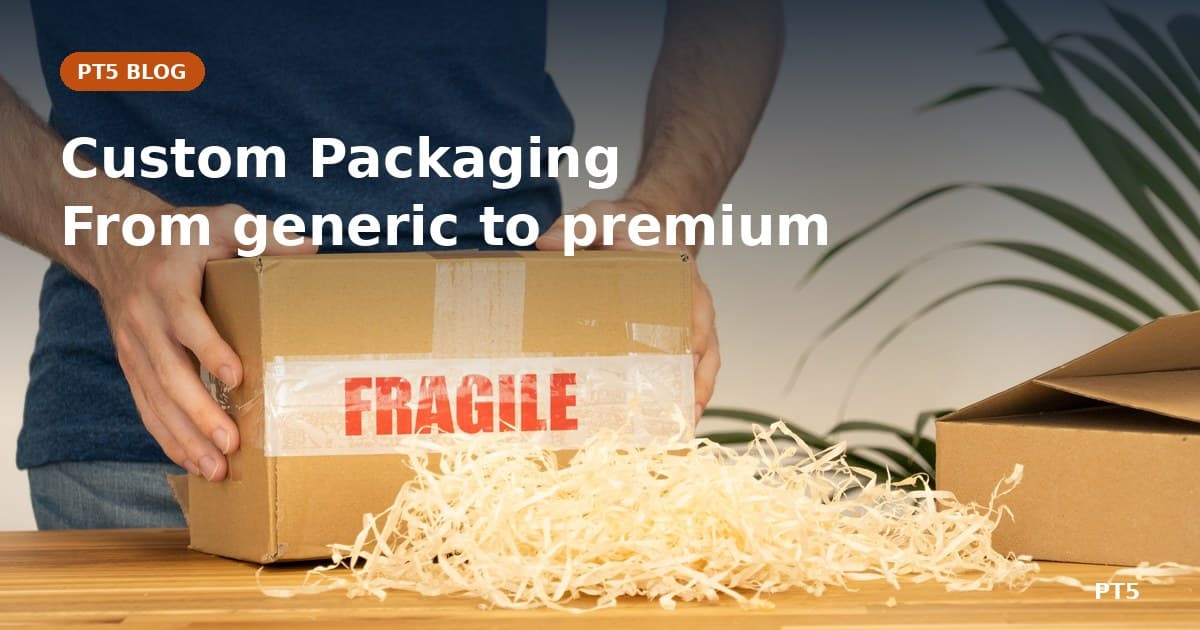
Two packages arrive on the same day.
Package A: a plain grey poly mailer. No logo. No insert. The product sits inside wrapped in a single layer of bubble wrap. It works fine. The customer doesn’t remember who they bought it from.
Package B: a branded mailer box with a logo printed on the lid. Inside, the product is wrapped in custom tissue paper. A thank-you card sits on top with a QR code linking to the brand’s Instagram. A small sticker sheet is tucked in as a bonus.
The customer takes a photo. Posts it on Instagram Stories. Tags the brand. Three friends ask “where did you get that?”
Same product. Same price point. Completely different outcome.
That’s the difference custom packaging makes.
This guide walks you through exactly how to go from Package A to Package B, with real costs, realistic MOQ expectations, and a few things nobody tells you about packaging weight and shipping.
Photo: Meanwell Packaging / CC BY 2.0 / via Wikimedia Commons. Cropped and resized.
Why Custom Packaging Actually Matters
1. Brand recognition is your only moat
In dropshipping, hundreds of sellers often offer the exact same product from the same supplier. Your product listing looks identical. Your price is within $1 of everyone else. The only thing that separates you from the next seller is whether the customer remembers your name.
Generic packaging says “I’m a middleman.” Branded packaging says “I’m a brand.” Over time, brand recognition drives repeat purchases, word-of-mouth referrals, and the kind of customer loyalty that no ad spend can buy.
2. Avoid product homogeneity
When every seller ships the same factory product in the same factory packaging, customers have zero reason to choose you over the next listing. Custom packaging breaks the cycle. It makes your product feel different, even when the item inside is identical to what’s available everywhere else.
3. Unboxing = free marketing
A branded unboxing experience gets shared on social media. Generic packaging never does. Every customer who posts your packaging is giving you free user-generated content that converts better than any ad, because it comes from a real person, not your marketing budget.
4. The trade-off nobody mentions: shipping weight
Here’s what most packaging guides won’t tell you: custom packaging adds weight, and weight adds shipping cost.
A poly mailer might weigh 30g. A branded corrugated box with tissue paper, insert cards, and stickers can weigh 150–300g. For international shipping, every gram counts.
| Packaging Level | Approx. Weight | Impact on Shipping |
|---|---|---|
| Poly mailer (generic) | ~30g | Lowest |
| Branded poly mailer + sticker | ~50g | Minimal |
| Mailer box + tissue + card | ~200g | +$1.50–3.00 per shipment |
| Rigid box + foam insert + full kit | ~400g+ | +$3.00–6.00+ per shipment |
For a product that weighs 200g, upgrading from a poly mailer to a mailer box can double your total package weight, adding roughly $1.50–3.00 per order in shipping depending on destination and shipping line. Sometimes that surcharge costs more than the packaging itself.
Before you go premium, run the math on your specific product weight, destination, and shipping method. The best packaging choice is the one that still leaves you profitable after shipping.
The MOQ Reality: Lower Than You Think

The most common objection to custom packaging is “the minimum order quantity is too high.” That was true five years ago. In 2026, the reality is quite different, especially if you work with a sourcing agent.
Packaging MOQs (with an agent)
| Packaging Item | MOQ | Cost per Unit |
|---|---|---|
| Logo stickers | 200–500 | $0.02–0.08 |
| Thank-you cards / insert cards | 200–500 | $0.03–0.10 |
| Custom mailer box | 200–500 | $0.30–0.80 |
| Custom rigid box | 500–1000 | $1.00–3.00 |
| Tissue paper (custom print) | 500+ | $0.05–0.15 |
All prices shown are estimates based on typical 2026 market rates. Your actual costs will vary based on product dimensions, material choices, print specifications, and supplier negotiation. Treat these numbers as planning references. Always get a formal quote for your specific project.
The key: a good agent knows the small packaging factories. Large factories quote MOQs of 1,000–5,000 units. But there are hundreds of smaller workshops (often just a few people with a printing press and a die-cutting machine) that will happily produce 200–500 units. The trade-off? Unit cost runs 30–50% higher than the 1,000-unit factory price.
Here’s the math that matters:
| Scenario | MOQ | Unit Cost (mailer box) | Total Spend |
|---|---|---|---|
| Large factory (direct) | 1,000 | $0.22 | $220 |
| Small workshop (via agent) | 300 | $0.33 | $99 |
You spend $99 instead of $220, and you only commit to 300 units instead of 1,000. For a new product or a seasonal test run, that difference is the entire game.
Your agent’s job is to know which small workshops deliver decent quality at acceptable prices. They visit them, check samples, and handle the back-and-forth in Chinese. You just approve the sample and place the order.
Each client’s packaging is unique: your boxes have your logo, not someone else’s. An agent will never merge your custom design with another seller’s order. That’s why the “group pooling” model doesn’t apply to custom packaging the way it does for generic products.
Excess packaging materials can be stored at your agent’s warehouse for future orders. You don’t need to use all 300 boxes in one shipment. They’ll hold inventory and pull from stock as your orders come in.
Product customization MOQs
Want your logo printed on the product itself? This is where it gets interesting:
- Traditional factory MOQ: Usually 500–1,000 units. Good for established sellers.
- With a customization service or small-scale equipment: You can start from as few as 1–10 units. Laser engraving machines, small-batch screen printing setups, and UV printers can handle single-unit customization without factory-level MOQs.
- Your agent’s workshop: Many sourcing agents now have in-house customization capabilities (logo printing, engraving, label application) that handle small batches daily.
The real bottleneck isn’t MOQ. It’s knowing who to ask and how to structure the order. Search for “custom packaging no MOQ” and you’ll mostly find ads. In reality, no workshop offers truly zero-MOQ custom printing: someone still has to set up the plate and the print file. But at roughly 200 pieces, the math changes completely.
What you can start with today (MVP)
For under $400 (typically $85–250), you can launch a fully branded packaging setup:
- 500 custom stickers → $10–40
- 500 thank-you cards → $15–50
- 200 custom mailer boxes → $60–160
- Total: ~$85–250
That’s it. No $5,000 minimum. No warehouse full of unsold packaging. Start small, iterate, scale what works.
Personalization: The Margin Multiplier Nobody Talks About
Most packaging guides stop at “put your logo on the box.” But there’s a deeper level of branding that drives margins, reduces refunds, and builds genuine customer loyalty: personalization.
What personalization does
When a customer orders something customized (their name engraved, their preferred color, a monogram, a custom message), three things happen:
1. Perceived value increases significantly
A generic insulated tumbler might sell for around $17. The same tumbler with the customer’s name laser-engraved? Often $30–40. The added production cost is typically only a dollar or two per unit. The margin difference is enormous.
2. Customers tolerate longer delivery times
Standard dropshipping delivery is already slow, and customers start watching the calendar around the second week.
Customized and engraved products take longer still, and customers expect to wait. They ordered something made specifically for them. Of course it takes longer. The psychological contract is completely different. Patience goes up, complaint tickets go down.
3. Returns become nearly impossible
Here’s the part that matters most for margins: personalized products cannot be easily returned or resold. A tumbler with someone’s name on it has zero resale value. The customer knows this. They’re far less likely to request a casual return because they ordered impulsively or found it cheaper elsewhere.
This isn’t about trapping customers. It’s about creating products they genuinely value and are committed to keeping.
The transparency requirement
Personalization only works if you’re transparent throughout the process. Customers who’ve paid for a custom product and are waiting several weeks need to feel informed, not ignored.
What to provide:
- Production updates with photos or video. Show the engraving happening. Show the quality check. A 10-second video of their name being laser-etched on the product is worth more than any marketing copy.
- Clear stage-by-stage updates. Tell customers which stage their order is in (in production, in quality check, or shipped) rather than leaving gaps of silence. When customers know where their order is, they don’t panic.
- Honest delay communication. If production takes longer than expected, tell them immediately, with a reason and a revised date. Customers forgive delays. They don’t forgive silence.
This transparency doesn’t just reduce support tickets. It builds trust that turns first-time buyers into repeat customers and brand advocates.
The 6 Levels of Custom Packaging

From the simplest (and cheapest) upgrade to the full brand experience:
| Level | What’s Customized | Cost/Unit | Best For |
|---|---|---|---|
| L1 | Thank-you card / care instructions | $0.03–0.10 | Every seller; no reason not to |
| L2 | Logo sticker / seal sticker | $0.02–0.08 | Instant brand recognition on any package |
| L3 | Custom mailer box (printed logo) | $0.30–0.80 | The “real brand” tipping point |
| L4 | Custom tissue paper / inner lining | $0.05–0.15 | Premium unboxing feel |
| L5 | Product branding (logo print / engraving / woven label) | $0.20–1.50 | True private label |
| L6 | Full suite (box + tissue + card + sticker + product branding) | $1.00–3.50 | Complete brand experience |
Where to start: Most sellers should begin at L1–L3. A thank-you card + logo sticker + custom box costs roughly $0.35–$0.98 per order. That’s the sweet spot between brand impact and cost.
When to go higher: L5–L6 make sense when you’ve validated product-market fit, you’re moving 100+ orders/month, and your retail price supports the added cost.
Real Cost Breakdown: Branding at Scale

Photo: Thirunavukkarasye-Raveendran / CC BY 4.0 / via Wikimedia Commons. Cropped and resized.
Here’s what custom packaging actually costs at different order volumes:
| Item | 200 units | 500 units | 2,000 units |
|---|---|---|---|
| Custom mailer box | $0.65 | $0.40 | $0.18 |
| Thank-you card | $0.08 | $0.05 | $0.03 |
| Logo sticker | $0.06 | $0.03 | $0.02 |
| Total packaging cost | $0.79 | $0.48 | $0.23 |
| Your product retail price | $19.99 | $19.99 | $19.99 |
| Packaging as % of retail | 3.9% | 2.4% | ~1.2% |
Unit prices drop fast between 200 and 1,000 units; after roughly 1,000 units, the mailer box price plateaus around $0.18–0.22.
At 200 units, branding costs you $0.79 per order. If it increases your repeat purchase rate by even 5%, the ROI is immediate.
The Global Custom Packaging Market Context

Understanding the broader market helps justify your packaging investment. According to Grand View Research, the global custom packaging market was valued at $39.7 billion in 2025 and is projected to grow at a CAGR of 6.0% from 2025 to 2030.
Fortune Business Insights provides a complementary estimate, valuing the market at $48.17 billion in 2025. While different research firms use varying methodologies, both projections confirm the same trend: branded packaging is not a niche. It’s a massive, growing industry.
What this means for dropshippers:
The 6% annual growth rate reflects increasing consumer expectations. Shoppers now expect brands, even small independent ones, to deliver a cohesive unboxing experience. Generic packaging signals “dropshipper”; branded packaging signals “legitimate business.”
As Ichiba OnePlatform’s branding guide notes, the typical brand upgrade path includes three core elements:
- Custom packaging (boxes, labels, seal stickers)
- Marketing inserts (thank-you cards, instructions, discount coupons)
- Product branding (logo printing, private labeling)
This framework aligns with our L1–L6 packaging levels above: start with inserts and stickers, progress to custom boxes, and eventually achieve full private label status.
Common Mistakes (That Cost More Than the Packaging)
1. Over-packaging a low-margin product
If your product sells for $10 and your custom packaging costs $3 + adds $2 in shipping, you just spent 50% of your revenue on presentation. Match packaging investment to product margin.
2. Ignoring destination market regulations
Destination markets have their own packaging and labeling rules. In the EU, depending on your product category, that can mean CE marks on certain goods, material declarations, or plastic packaging taxes. If you’re shipping branded packaging to Europe, make sure your materials comply. Non-compliance fines are far more expensive than proper packaging.
3. Designing for the screen, not the printer
Your logo looks great on a Retina display. But print it at 2cm wide on a corrugated box and suddenly the fine details are illegible. Material substitution is the sneakiest version of this: your approved sample shows 350gsm card, and the bulk order quietly arrives at 250gsm. Always test print a physical sample, and weigh and measure the first production run against your approved sample before accepting it.
4. No call-to-action on your packaging
Your thank-you card and box are prime real estate. Don’t waste it. Include:
- A QR code to your website or social media
- A request for review or user-generated content
- A discount code for the next purchase
- Contact info for customer support
5. Forgetting about shipping weight
We mentioned it above, but it bears repeating. Before finalizing your packaging design, weigh a fully packed sample and run it through your shipping calculator. The beautiful rigid box that adds $4 to every shipment might not be so beautiful when you see your margins.
How to Get Started with PT5
Custom packaging sounds great in theory. The execution (finding packaging suppliers, negotiating MOQs in Chinese, reviewing print files, coordinating warehouse assembly) is where most sellers get stuck.
Here’s what we handle:
- Packaging sourcing: We find packaging suppliers on 1688, negotiate MOQs in Chinese, and get you samples for approval before production.
- Low-MOQ packaging sourcing: We work with small packaging workshops (not just big factories) to bring MOQs down to 200–500 units. Yes, unit cost runs 30–50% higher than factory-direct at 1,000+ units, but your total cash outlay is a fraction, and you’re not sitting on 700 unused boxes.
- Design file review: We check your artwork against the printer’s specs (color mode, bleed lines, resolution) before it goes to production. No more “the color looked different on screen” surprises.
- Warehouse assembly: Products arrive at our warehouse. We add your packaging, do quality inspection, and ship, all in one workflow.
- Material storage: Excess packaging materials stay in our warehouse for your future orders. No waste, no storage fees on unused inventory.
- Custom branding services: Product logo printing, laser engraving and label application, available for both small and large batches.
- Personalization workflows: Interested in offering custom engraved or personalized products? We can set up the production and QC workflow, including the photo/video update system for your customers.
You don’t need PT5 to do custom packaging. But if you’ve ever been quoted “MOQ 3,000” and didn’t know how to push back, it might be worth a conversation.
Send PT5 your product and packaging ideas on WhatsApp, and we’ll come back with a realistic MOQ and an all-included quote: sourcing, branding, assembly and shipping.
FAQ
Can I do custom packaging with less than 100 orders per month?
Yes. If you’re a small business shipping under 100 orders a month, this is exactly where to start. Begin with L1–L2 (thank-you cards + stickers). MOQs are typically 200–500 units, and the total investment is under $50. Upgrade to custom boxes when your volume justifies it. A sourcing agent can connect you with small packaging workshops that accept 200–500 unit orders. Unit cost runs 30–50% higher than bulk factory pricing, but your total spend is dramatically lower.
How long does packaging production take?
Stickers and cards typically run 3–5 business days; custom boxes usually take 7–15 business days depending on complexity. Always order a sample first, and plan on a few extra days for it. It saves you from receiving 2,000 boxes with the wrong Pantone shade.
Does custom packaging slow down fulfillment?
It typically adds 1–2 business days per order for the packing step (box assembly, product placement, tissue wrapping, card insertion, sealing, labeling). If your agent has a dedicated packaging line, this is streamlined. Ask about their packaging workflow before committing.
Do I need to design the packaging myself?
No. Canva works for simple designs. Freelance designers on marketplaces like Fiverr typically charge $20–50 for a simple professional layout. Your packaging supplier usually provides free die-cut templates. And your sourcing agent can review files before they go to print.
What about personalization? Is it worth the extra complexity?
For the right product, absolutely. Personalization increases perceived value, reduces price sensitivity, extends customer patience on delivery, and virtually eliminates returns. The key is providing transparent production updates (photos/video) so customers feel involved, not forgotten.
Related Articles
- 1688 vs Taobao vs AliExpress (2026): Where to Source from China
- How to Negotiate with Chinese Suppliers: 7 Scripts That Actually Work
- Our 15-Point QC Checklist: Complete QC Guide from China
Have Your Say
Disagree with our cost estimates? Found a cheaper packaging supplier? Have a personalization success story (or disaster)?
Leave a comment below. We read every message and update this guide based on real seller feedback.
Sources (transparency note)
- Grand View Research: Custom Packaging Market Analysis — global market size ($39.7B in 2025) and CAGR (6.0%)
- Fortune Business Insights: Custom Packaging Market — complementary market size estimate ($48.17B in 2025)
- Ichiba OnePlatform: Chinese Dropshipping Suppliers Guide — brand upgrade framework and OEM/ODM paths
- 1688.com packaging supplier listings — live supplier MOQ and pricing references
- PT5 internal packaging order data (anonymized)
All unit-cost, weight and MOQ figures are planning estimates based on publicly available market data and PT5’s anonymized order history. Actual costs vary by product dimensions, materials, print specifications and negotiation. Always get a formal quote for your specific project.
PT5. People First, Transparent, honoring our Five Commitments. Sourcing, QC, custom branding, warehousing, photography, and dropshipping fulfillment in China.
Last updated: September 2026
Comments
Have your say. Share practical experience, point out something we missed, or ask a follow-up question.
Loading comments...
Join the conversation
Log in with your PT5 account to comment or vote.
Log in to commentNew to PT5? Create an account