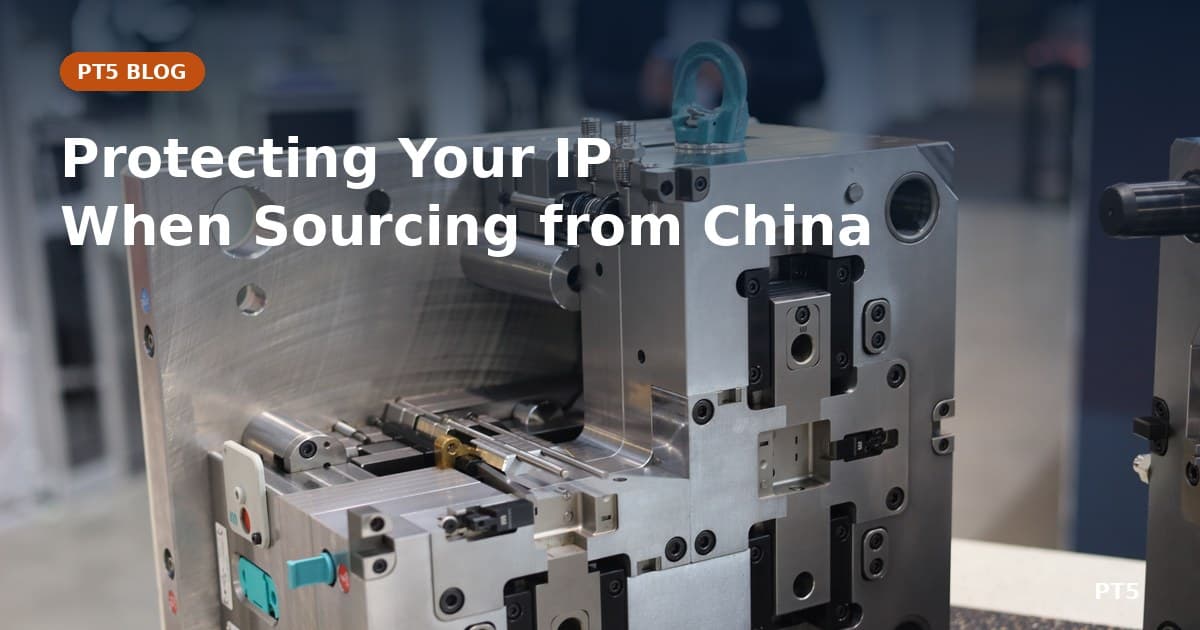
You found a factory that answers fast, the samples look right, and the quote finally makes sense. Then you send the drawings. From that moment, everything needed to make your product lives in somebody else’s workshop, and no screenshot of a signed contract will pull it back. The uncomfortable truth about intellectual property in China manufacturing: protecting it is not a legal formality you handle later. It is part of the sourcing job itself, and the buyers who treat it that way are the ones still selling their own products two years on.
The losses follow a few familiar patterns. The product you have not launched yet appears on wholesale platforms. The mold you paid for runs parts for somebody else. Your supplier quotes your competitor against you. Your brand name gets registered in China by a stranger, and suddenly the buyer who paid to build the brand is the one answering the infringement complaint.
This article covers where the leaks happen, which tools actually hold, and what to do when something slips through anyway. Every official figure is sourced and current as of September 2026; agency and legal fees are practical ranges, quoted case by case.
One boundary first: PT5 is not a law firm and does not provide legal consultation. This article is sourcing practice, not legal counsel, and the legal moves (filing, recordal, complaints, litigation) belong to licensed agents and lawyers. What PT5 does sits inside the sourcing process: our China entity signs the three-party NNN alongside your company and the supplier; we run routine checks, keep samples and evidence on file, and coordinate with licensed Chinese lawyers when enforcement is needed. The coordination is free of charge as part of the sourcing service; official fees, agency fees and legal fees are paid as incurred. None of what PT5 does is legal advice.
Photo: Bricetofly / CC0 / via Wikimedia Commons. Cropped and resized.
Where IP Actually Leaks: Four Routes

Route one: your design gets copied. The moment your drawings reach a factory to make samples, every piece of information needed to produce your product is on their floor. The factory does not need to leak the file to anyone. They can study it, tool it, and list the same product on a wholesale platform under their own brand. No third party is involved at any step, and that is exactly why a standard NDA often cannot reach it. More on that in the next section.
Route two: your mold walks away. You paid for the tooling, but the mold sits in the factory’s workshop. If ownership is not written into a contract, physical control belongs to whoever holds the mold. Things stay quiet while the relationship is good. The day you switch suppliers, or the day the factory fills gaps between orders, your mold can keep running for other customers.
Route three: the supplier also supplies your competitors. Traders posing as factories and copy-first workshops often carry your competitor on the same customer list as you. The price you negotiated, the volume you promised, your sales velocity: all of it becomes leverage for the next negotiation, against you. This is not infringement in the legal sense, and it still hurts.
Route four: your trademark gets squatted. China runs a registration-based system (Source [1]): whoever files first owns the right in practice, with only narrow, costly-to-prove protections for a mark already in use. An unregistered brand in China is an open door. Anyone can register it, then complain against you, and the one answering the takedown at the port or on the platform is the buyer who paid to build the brand. Section 4 covers how to get ahead of this.
Four leaks, four classes of tools. Contracts address routes one and three. Ownership arrangements address route two. Registration addresses route four. The rest of the article walks through each.
The NDA Reality: From NDA to NNN

Most buyers know to sign a confidentiality agreement before sending drawings. The problem is that the standard NDA covers one thing: do not disclose my information to third parties. The most damaging leaks in China manufacturing do not involve a third party at all. The factory uses your files in its own workshop: a second set of molds, a second brand, a new listing on a B2B platform. Nothing was disclosed, so the NDA never fires.
The tool built for this situation is the NNN agreement: Non-Disclosure, plus Non-Use (the factory may not use your information to make competing products for itself or anyone else) and Non-Circumvention (the factory may not go around you to reach your customers or distributors). NNN is contracting practice, not a statute. Its teeth come from how it is drafted (Source [10]).
Three elements decide whether it holds in China, and all three are required:
-
PRC governing law. An NDA governed by California or English law will not be applied the way you expect in a Chinese court. Foreign judgments are hard to enforce against a Chinese manufacturer, and the enforcement path is long enough that most small and mid-size buyers never finish it.
-
A Chinese-language text. With an English-only contract, the judge reads the court’s own translation. Your carefully drafted English clauses do not bind the bench. The standard practice is bilingual drafting with the Chinese text controlling.
-
A Chinese court or arbitration venue. Disputes need to land somewhere the outcome can actually be executed. That means China.
Then there is the question of who signs. For a custom product, the cleaner structure is a three-party agreement: your company (the rights holder), the supplier (the party bearing the obligations), and PT5’s China entity (the coordination and record-keeping party). The supplier’s non-disclosure, non-use and non-circumvention obligations run directly to your company, so the claim in a dispute is yours, not one step removed through an agent. PT5’s China entity joins as the third party and handles execution oversight, file keeping and evidence coordination. Ask PT5 on WhatsApp for a de-identified sample of this three-party structure; have a licensed lawyer review the final version before signing.
Recent regulation strengthens the contract’s footing. The revised Anti-Unfair Competition Law took effect October 15, 2025, and the market regulator’s Provisions on Trade Secret Protection (Order No. 126) took effect June 1, 2026. Article 9 lists a signed confidentiality agreement, or confidentiality obligations agreed in a contract, as one of the recognized “confidentiality measures” the trade secret definition requires (Source [6]). A properly drafted NNN therefore also locks in the administrative protection route.
One limit to know: Article 15 confirms that reverse engineering a lawfully purchased product is generally not treated as infringement. Once your product hits the market, trade secret protection thins out. What still binds the factory at that point is the contractual non-use clause, not the trade secret statute.
Set expectations for what a contract is. It is not a safe. A determined factory can breach it. What it does is write the cost of breach in black and white and hand you a clear claim when something goes wrong. Paired with the registration moves in Section 4 and the structure moves in Section 3, it forms an actual defense instead of a comfort object.
Own the Mold: Tooling and Design Files
Put mold ownership in writing. For any custom product, the contract needs three hard sentences: the mold is paid for by the buyer and owned by the buyer; when cooperation ends, the mold is returned to the buyer or destroyed at the buyer’s instruction; the factory may not use the mold for any third party without written consent. Those sentences are the direct evidence in any later dispute over whose mold it is. Write them before the tooling is cut, not after.
Split the supply chain. A complete product usually involves casings, hardware, electronics and packaging from different hands. Split the orders: the casing shop never sees the circuit design, the assembler handles semi-finished parts, the packaging printer only sees print files. No single supplier can assemble the full picture. This is structural protection at zero direct cost. The price is coordination: lead times and quality control get more complex, which is one of the core jobs a sourcing agent is for.
Keep critical processes in your own hands. Core formulas, software, proprietary processes: if they do not need to enter the factory, keep them out. Flash the firmware yourself before shipment. Buy the key raw material and supply it pre-mixed. Disclose drawings in stages: dimensions and tolerances for sampling, the full package only after cooperation is confirmed.
Do the boring file work. Number and watermark every drawing, log who received it, track where samples go, keep quotes on a need-to-know list. None of this replaces legal protection. All of it determines whether, after an incident, you can say what leaked and when, which is the backbone of any trade secret claim.
File Your Trademark First, Then Record It with Customs
China’s trademark system is registration-based: no registration, no right. A squatter does not need to sell anything; the registration itself becomes leverage, either a settlement demand or a complaint against your listings. So the filing date is not a “later, once the product takes off” task. The right time is when you commit to the product, and no later than launch.
Cost and timeline (official figures): the CNIPA online filing fee is CNY 270 per class (about US$40), covering 10 goods or services items, CNY 27 per extra item. Examination averages 4 months, the publication window runs 3 months, and the general registration cycle has been compressed to 7 months (Sources [1][3]). In 2024 alone, 4.781 million trademarks were registered in China (Source [2]). In that crowd, filing late usually means filing into a collision.
Foreign applicants file through a licensed Chinese agency (Trademark Law, Art. 18). In practice, budget roughly CNY 2,000-3,000 per class for agency fees plus CNY 1,000-1,500 for a clearance search (Source [3]). Do the search: China layers subclasses inside its 45 classes, and filing only the broad class heading leaves room for a squatter to register a near-identical mark one subclass over.
Register the Chinese mark too. The classic miss is filing only the English mark. In Chinese e-commerce, the transliterated or translated brand name often circulates more than the original, and it is the first thing squatters take. Cover the core product class plus Class 35 (retail and advertising services) at minimum, and let your agent map the rest to the product line.
After registration, add the customs recordal. Filing with the General Administration of Customs is free of charge, with a committed processing time of 30 working days (Source [4]). The recordal is valid for 10 years from approval and can be renewed within the 6 months before expiry, each renewal running 10 years (Source [5]). With the recordal in place, customs has the basis to act on suspected infringing goods in import and export channels. Your trademark goes from “available to squat” to “protected at the border.”
If the product’s look is the selling point, a design patent is the third registration route: 15 years from filing under the Patent Law as amended in 2020 (Source [7]). Which combination fits (trademark, design patent, or both) is a question for your agent.
Contract Clauses and Factory Visits
Contract terms earn their keep through deterrence and damage control. The drafting principle that matters most: enforceability beats completeness. A penalty clause with a specific amount or a clear calculation formula does more work than “compensate all losses,” because the vague version hands the burden of proof back to you.
Worth writing into the agreement:
-
Confidentiality clause: defined scope (drawings, molds, quotes, order volumes, customer information), term (while cooperating plus a number of years after termination), and a permitted-knows list limited to staff who need the information, with the factory responsible for its subcontractors’ compliance.
-
Mold clause: the three mold sentences in Section 3, plus maintenance responsibility and a written scrap-out procedure.
-
Exclusivity: for custom products, “no production of the same or a similar product for any third party without consent,” with the term and the product scope spelled out. “Exclusive” without a scope and a deadline enforces as nothing.
-
Breach clause: penalty amount or calculation method, allocation of legal costs, and dispute resolution under PRC law with a Chinese court or arbitration commission.
Three things to look at when you visit the factory. Whether the sample room displays rows of other clients’ designs in your category (copy-work as the business model leaves traces). Whether the warehouse and document management look controlled (that is how your drawings will be treated too). Who else they serve in your category, and whether they answer the question (a real factory answers; a trader deflects). None of this replaces due diligence. All of it helps you filter out factories with no confidentiality culture before the drawings leave your hands.
If It Happens Anyway: The Enforcement Ladder

When the copy shows up, work the ladder from cheapest to most expensive. Every rung has a precondition, which is the payoff of Section 4: platform complaints and customs protection both require that you hold a registered trademark (or a patent).
Rung one: platform complaints. On Amazon, a trademark owner can enroll in Brand Registry (more than 350,000 brands have, per the UK government’s e-commerce IP guide) and use Report a Violation to file takedowns, with Project Zero for self-service counterfeit removal and Transparency item-level serialization as the heavier tools (Source [8]). On the Alibaba group, register for free on the IPP platform (ipp.alibabagroup.com), submit trademark or copyright proof once, and file complaints against infringing listings across Alibaba.com, 1688 and AliExpress under the notice-and-takedown flow (Source [9]). Platform complaints are cheap and fast, and they cut links, not roots. First aid, not the cure.
Rung two: administrative complaints. File with the market supervision authority where the infringer operates (the national 12315 channel accepts reports). The 2026 trade secret provisions place administrative protection squarely with the market regulator (Source [6]); design patent disputes can go to the IP office for administrative adjudication. Fast and low-cost for clear-cut facts.
Rung three: the lawyer’s letter. A local Chinese firm sends the factory a demand letter with your registration certificate and an infringement comparison. A large share of small factories pull their listings and retire the mold at this stage, because the cost of continuing is already written into the contract you signed.
Rung four: customs seizure and litigation. With a customs recordal in place, you can request customs protection against infringing goods in trade (Sources [4][5]; customs may require a deposit when protection is requested). For serious cases, sue in a Chinese court for an injunction and damages. Foreign judgments are hard to enforce here, which is why the suit belongs in a Chinese court, and why the three elements in Section 2 were worth insisting on. When a case reaches these rungs, PT5 coordinates the lawyer on your behalf and hands over the evidence file kept since day one.
The order flexes; the direction does not. Stop the bleeding (platforms), raise the pressure (administrative complaints plus a lawyer’s letter), then decide it (customs and courts). Rungs one to three cost less than most buyers expect, provided the registration work was done first; the last rung costs what serious litigation costs anywhere, which is exactly why the earlier rungs exist.
What Each Protection Costs and Returns

Photo: Encik Tekateki / CC BY-SA 4.0 / via Wikimedia Commons. Cropped and resized.
| Measure | Direct cost | What it blocks | What it does not |
|---|---|---|---|
| NNN agreement | One-off lawyer drafting fee (hundreds of US dollars if DIY; PT5 clients: free coordination) | Disclosure, self-use, circumvention | Enforcement still runs through Chinese procedures |
| China trademark registration | CNY 270/class official fee + about CNY 2,000-3,000/class agency + CNY 1,000-1,500 search | Squatting, platform complaints without standing, customs protection without standing | Does not stop design copying |
| Customs recordal | Free (10-year validity, renewable) | Border protection against infringing goods | Requires a trademark or patent first |
| Design patent | Official fees + agency fees (case by case) | Identical-look copying (15-year term) | Functional innovation needs an invention patent |
| Split ordering | Zero (organizational cost; more complex logistics) | Any single supplier holding the full picture | Coordination and QC overhead rises |
| Factory visits + contract terms | Travel / escort costs | Filters out low-confidentiality suppliers | Not legal protection in itself |
(Fee and timeline figures: Sources [1][2][3][4][5][7]; agency fees and the NNN drafting fee are practical ranges, quoted case by case. Customs recordal is free to file; requesting customs protection may require a deposit under customs rules. For PT5 clients, the coordination work in Section 8 is free; official, agency and legal fees are paid as incurred.)
The way to read this table: trademark registration and customs recordal are the two highest-value cells, one buys the entry ticket cheaply, the other is free. NNN and split ordering protect the process. Beyond the table, spending real attention on factory visits and contract drafting costs less than any lawsuit you would file later.
How PT5 Handles Your IP
For PT5, IP protection is part of the sourcing workflow, not a cleanup after something goes wrong. Four engagements. The coordination is free as part of the sourcing service; official fees, agency fees and legal fees are paid by the client as incurred.
We put the three-party NNN in place through our China entity. The three parties: your company (the rights holder), the supplier (the party bearing the obligations), and PT5’s China entity (coordination and records). The non-disclosure, non-use and non-circumvention obligations run directly from the supplier to your company, so the claim is yours to enforce; PT5’s China entity handles execution oversight, file keeping and evidence coordination. Chinese-language text, PRC governing law, a Chinese venue.
We check the goods, and the check doubles as an IP checkpoint. Every order that runs through PT5 gets a routine check at our warehouse free of charge: photos, weights and quantities against the packing list. For orders that warrant it, we schedule golden-sample comparisons plus in-line and pre-shipment inspections at the factory, a paid on-demand QC service quoted per day before you commit. Inspections double as IP checkpoints: what comes off the line is checked against what you approved, so a copied design or an unauthorized process change is flagged before anything ships.
We keep the samples and the evidence. Sealed samples, order records, communications and inspection reports stay on file, dated and organized, at no extra charge. If a design ever gets copied, what reaches the lawyer is a documented trail, not a scramble through old chat logs.
We coordinate the Chinese lawyer for you. When enforcement is needed, PT5 contacts licensed Chinese lawyers on your behalf and coordinates the case: demand letters, administrative complaints, customs seizure requests, litigation. The legal work stays with the lawyers; the coordination, the documents and the factory-side facts stay with us. The lawyer’s fees are agreed directly between you and the lawyer.
The boundary, as always: PT5 does not provide legal consultation, and none of the four engagements constitutes legal advice. The legal actions themselves are performed by the licensed lawyers we coordinate for you.
Have designs or tooling to protect? Message PT5 on WhatsApp before the first quote request goes out. The three-party NNN, the routine checks, the evidence file and the lawyer coordination are all part of the sourcing service at no extra charge; third-party official, agency and legal fees are paid as incurred.
The Short Version
The efficiency of China’s supply chain is real, and so is the leak risk. Holding your IP comes down to four moves: sign the right contract (a three-party NNN with PRC law, a Chinese text, and a Chinese venue), structure the work (mold ownership in writing, supply chain split), register early (trademark first, customs recordal free), and know the ladder (platform complaints, administrative complaints, lawyer’s letter, customs seizure and litigation).
The expensive move is always “deal with it after it happens.” The official filing fee is CNY 270 per class and customs recordal is free. Protection costs less than most buyers assume, and the window is shorter than they hope.
The PT5 teams serving factories all over China run these disciplines on every order, every week. One message on WhatsApp starts it: the three-party NNN goes in through our China entity, the goods get checked, the evidence stays on file, and when a copy happens, a licensed Chinese lawyer takes the case with our coordination. The coordination is free; official, agency and legal fees are paid as incurred. And none of this is legal advice.
Sources
[1] National Intellectual Property Administration (CNIPA), Trademark Office, “China’s Trademark Registration System” (registration-based system; examination averages 4 months; 3-month publication period; general registration cycle compressed to 7 months): https://english.cnipa.gov.cn/attach/0/1cf9b4beb66f4feebca0bf5f591d19d6.pdf
[2] CNIPA Annual Report 2024 (6.675 million trademark applications examined, 4.781 million registrations in 2024): https://english.cnipa.gov.cn/attach/0/fc2faf1e46bb41e6854124158b8e3009.pdf
[3] CNIPA official trademark fees (CNY 270/class online, CNY 300 paper, CNY 27/30 per extra item; official 2019 fee schedule, effective 2019-07-01): [CNIPA official fee page URL — to be inserted before publishing]; practical agency fee ranges (CNY 2,000-3,000/class, search CNY 1,000-1,500): https://cnpatentoffice.com/zh/guides/china-trademark-fees/ and https://olachina.org/china-trademark-registration/
[4] General Administration of Customs, online service guide for the IP recordal (free of charge, committed 30 working days): https://online.customs.gov.cn/treeGuide/?taskId=002029002000
[5] Regulations of the PRC on Customs Protection of Intellectual Property, Article 10 (10-year recordal validity, renewal rules): https://www.gov.cn/gongbao/content/2019/content_5468830.htm
[6] SAMR Order No. 126, Provisions on Trade Secret Protection (published 2026-02-24, effective 2026-06-01; Art. 9 confidentiality agreements, Art. 15 reverse engineering): https://www.gov.cn/gongbao/2026/issue_12766/202605/content_7070596.html (under the revised Anti-Unfair Competition Law, effective 2025-10-15)
[7] Patent Law of the PRC, Article 42 (design patent term 15 years, as amended 2020-10-17, effective 2021-06-01): http://www.npc.gov.cn/c2/c30834/202010/t20201019_308327.html
[8] UK Government, “Protecting intellectual property rights on e-commerce stores” (Amazon Brand Registry 350,000+ brands, Report a Violation, Project Zero, Transparency; updated April 2026): https://www.gov.uk/government/publications/protecting-intellectual-property-rights-on-e-commerce-stores/protecting-intellectual-property-rights-on-e-commerce-stores
[9] Alibaba Intellectual Property Protection (IPP) Platform (platform principles and policies; complaint flow; covers Alibaba.com/1688/AliExpress and more): https://ipp.alibabagroup.com/policy/en.htm and https://activity.alibaba.com/page/ipr_qa_detail01.html
[10] Cross-border NNN agreement practice (PRC law / Chinese text / Chinese venue; NDA covers disclosure only): Kelly Zhang Law (2026-03) https://kellyzhanglaw.com/en/blog/supplier-copied-your-design and Mondaq (2026-08) https://www.mondaq.com/china/contracts-and-commercial-law/1836330/do-i-need-a-china-nnn-agreement-or-a-china-manufacturing-agreement-usually-both
Comments
Have your say. Share practical experience, point out something we missed, or ask a follow-up question.
Loading comments...
Join the conversation
Log in with your PT5 account to comment or vote.
Log in to commentNew to PT5? Create an account