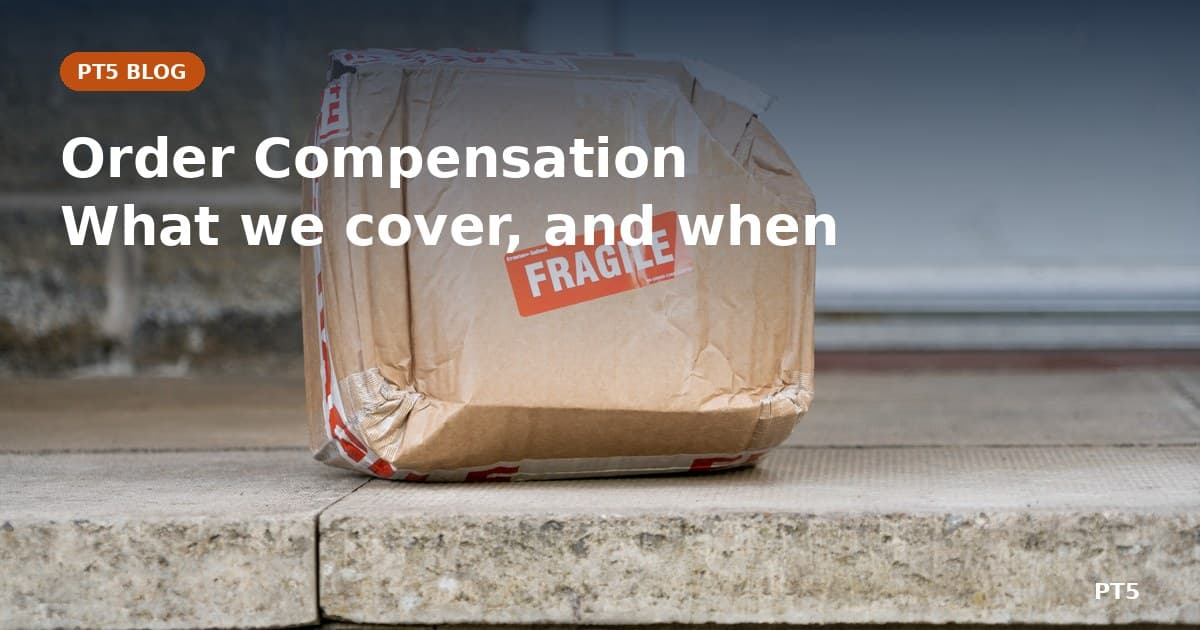
A box leaves Shenzhen with $400 of inventory inside. Between the export scan and the buyer’s porch it can vanish, arrive crushed, or get pulled aside at customs with no explanation attached. The carrier’s published ceiling for that kilogram, when the air treaty applies, is about $34 (Source [7]). The marketplace has already refunded your buyer from your balance. The supplier points at the handoff scan. Three counterparties, three refusals, and the loss lands exactly where it started: on the seller.
PT5’s answer is Order Compensation, optional coverage attached to an order when you place it, covering the four failure modes nobody else owns end to end. Below: what is covered, what is not, how a claim moves, how the official terms compare. Every number is an official PT5 term or carries a source you can open.
Photo: Meanwell Packaging / CC BY 2.0 / via Wikimedia Commons. Cropped and resized.
The Losses Are Real — Lost, Stolen, Misdelivered, Seized

Pitney Bowes counted 22.3 billion parcels shipped in the US in 2024, with about 23.5 billion forecast for 2025 (Source [1]). A 2026 industry review citing McKinsey’s 2024 analysis puts the US last-mile loss rate at roughly 1.5%, which on those volumes is on the order of 330 million parcels a year going missing in a single country (Source [1]).
SafeWise’s 2025 survey counted about 104 million packages stolen in twelve months, roughly $15 billion in consumer losses, theft at about one third of all package losses, and 43% of surveyed US consumers affected (Source [1]). An operator-focused count drawing on Security.org data runs higher, about 1.7 million parcels a day and more than 620 million a year, because it folds porch theft into a lost-and-stolen total rather than pure transport loss like the 1.5% estimate above (Source [2]). Misdelivery adds its own layer: in a two-year BuySafe survey, 27% of respondents said a package went to a wrong address (Source [3]).
Customs seizure is the least quantified and least recoverable category. US Customs and Border Protection recorded 57,360 trade seizures in fiscal year 2025, up from 48,444 in FY2024; intellectual-property-right seizures made up 25,079 of them, with a manufacturer’s suggested retail value of $7.35 billion (Source [4]). Tens of thousands of cases a year, precisely where carriers disclaim liability.
What Carriers and Platforms Actually Pay — the Default Ceiling
For lost package compensation, the official defaults stack up like this.
The air treaty. Where the Montreal Convention applies, cargo liability is capped at 26 SDR per kilogram, about $34, a limit ICAO raised effective 28 December 2024 (Sources [6][7]). Article 18 also hands carriers standing defenses, among them inherent defect and acts of public authorities, the clause that makes customs seizure a carrier non-event (Source [5]).
China Post. The official EMS notice is blunt: mail without declared-value protection that is lost or damaged is compensated at actual loss up to the postage collected; ePacket disclaims delay, damage and loss entirely (Source [8]). UPU baselines cap EMS liability at 130 SDR per piece (Source [9]).
Freight forwarders. YunExpress’s terms cap compensation for parcels lost or damaged under their control at $30 per waybill, against proof of value, adjudication reserved to YunExpress (Source [10]). 4PX’s terms: no compensation for partial loss or damage, total loss against declared value capped at $100, written claims within 30 days, only after freight is paid in full (Sources [11][12]). AliExpress’s rules, run by Cainiao, pay up to 300 yuan for a lost registered parcel and 10% of value capped at 30 yuan for outer-box damage, evidence within 72 hours (Source [13]).
The integrators. DHL Express limits liability to the greater of $100 or $20 per kilogram (Source [14]); its own guidance concedes standard liability often falls short of the goods’ value (Source [15]). FedEx’s Asia-Pacific conditions carry the same ceiling, the greater of $100 per shipment or $9.07 per pound, with written claims within 21 calendar days (Source [16]). UPS takes declared value up to $50,000, but above $1,000 a driver-endorsed high-value summary is required or the ceiling reverts to $1,000 (Source [17]); once a package scans delivered, porch theft counts as the contract fulfilled (Source [18]).
The platforms. eBay’s protections shield metrics and reviews in item-not-received disputes; they do not pay for goods (Source [19]). Ship on time with a tracked eBay label and a newer layer applies: if the item lands after the buyer has been refunded, eBay reimburses the item cost; a carrier with sufficient time that still has not delivered leaves the refund with the seller (Source [20]). Third-party analysis is blunt: the buyer is refunded first, the seller chases the carrier, and carrier claims become unusable as the primary remedy (Source [21]). Amazon’s A-to-z process can auto-award the claim to the buyer and count it against your order defect rate when you miss the 48-hour response window; on-time Buy Shipping and 48-hour replies keep granted delivery claims off your account health (Source [22]). PayPal’s seller protection requires proof of shipment or delivery to the transaction address and does not cover item-not-received claims escalated into chargebacks (Source [23]), with a signature requirement above $750 sold through Shopify (Source [24]). Shopify documents payment-side protections, not shipping-loss compensation; the coverage layer lives in third-party checkout apps, the largest being Route (Sources [24][25]).
The pattern: default shipping protection from carriers and platforms is a fraction of the goods’ value or a service metric, not money. That is the gap a written plan has to close.
What PT5 Order Compensation Covers — Four Failure Modes and Published Rates

PT5’s Order Compensation is optional coverage attached to an order when you place it, charged only if you select it, chosen per order. The plan covers four failure modes: product quality defects, damaged packaging from water, impact and similar transit hazards, customs seizure or detention, and delivery delays beyond 30 days. Carrier misdelivery is covered as well: when the carrier delivers to the wrong address and the address the buyer supplied was correct, the loss is claimable; the exclusion in Section 4 applies to address errors the buyer itself made.
The fee is a small percentage of order value, set by product type:
| Product type | Risk profile | Rate |
|---|---|---|
| General Goods | Standard | 2% |
| Battery Included | Product with battery plus spare | 3% |
| Sensitive Items | Liquids and lawful, identifiable powders | 4% |
| Branded products (with proof of authorization to sell) | Brand-name goods | 5% |
| Batteries Only | Pure battery | 6% |
| White powder that is prohibited or unidentifiable | Banned by law or customs, or composition cannot be identified | Not covered |
Two rules set what a covered claim can pay. Minimum coverage equals 100% of the PT5 service fees on the order, so even the smallest covered loss returns the fees you paid. Maximum coverage is 120% of your store’s selling price, on net order value excluding local taxes. Official illustration: $50 of PT5 service fees, a $50 minimum; a $100 selling price, a $120 maximum. Orders above $100,000 get a tiered-risk custom quote.
Rates are not frozen: PT5 may adjust rates every 30 days based on claim ratios, with at least 3 days of notice. If claims run hot, the rate follows, and you hear before it takes effect.
Band mapping follows product type: electronics with batteries, glass and ceramics, liquids and powders that attract customs attention. To map your catalog, message PT5 on WhatsApp (join the chat); a documented answer, not a negotiation.
What It Does Not Cover — the Exclusions, Printed in Full

A plan that claims to cover everything is telling you its claim decisions are arbitrary. This one prints its exclusions like its rates:
- White powder that is prohibited or unidentifiable. Powders banned by law or customs, or whose composition cannot be identified, cannot be covered, zero liability, no exceptions. Lawful, identifiable powders sit in the Sensitive Items band at 4%.
- Buyer’s incorrect address. Losses from address information the buyer supplied incorrectly are not covered; the failure is real but not a transit failure. When the address was correct and the carrier delivered to the wrong one, that is misdelivery, covered (see Section 3).
- Legal seizures. Confiscation because the goods violate the destination country’s law sits outside coverage. Seizure or detention as a transit event is covered; goods unlawful in the destination market are not.
- Counterfeit or unauthorized goods. Items infringing trademarks or other IP rights are not covered; seizure of such items falls under the legal-seizure exclusion.
- Theft after the delivered scan. Porch theft after confirmed delivery is not covered: the delivered scan closes the carrier’s contract, and this plan’s loss rules attach to shipments that never arrive.
- Normal wear and tear. Damage from ordinary use after a confirmed delivery is not a transit loss.
- Late claims. A claim filed more than 5 days after the shipment shows delivered is automatically void. Five days is enough to inspect on arrival, printed so it can never be a surprise. A never-delivered parcel runs on the deemed-lost rule in Section 5 instead.
Read against Section 2, the list is short for what it covers. Carriers disclaim acts of public authorities wholesale, swallowing every customs event (Source [5]); PT5 covers seizure and detention as a category, carving out only the legally forfeit corner.
How a Claim Works — Five Days, Three Tiers, Seven Business Days

The clock. Claims must be filed within 5 days of the delivered scan; later, the claim is void, no discretionary grace period. A parcel that never shows delivered never starts this clock: when 30 business days pass from warehouse dispatch, the day the parcel leaves the PT5 forwarding warehouse (not the factory ship date), without the order having arrived, the shipment is deemed lost and claimable as an undelivered loss.
The filing. Claims go into your dedicated PT5 WhatsApp service group, where your orders and tracking questions already run. Evidence goes in the thread, PT5 reviews it there, and the record of what was submitted, decided and paid stays visible to both sides.
The decision runs on three tiers, all on the record:
| Tier | Applies to | Evidence required | Pays |
|---|---|---|---|
| Full Compensation with Evidence | Quality defects, damaged packaging | One clear photo: shipping label, damaged product and packaging in the same frame | 100% of coverage amount |
| Fast Compensation without Evidence | Quality defects, damaged packaging | No photos; faster processing | 70% of coverage amount |
| Full Compensation without Evidence | Customs seizure; delays beyond 30 days; loss deemed 30 business days from warehouse dispatch | No photos; seizure, the 30-day-plus delay and the missed 30-business-day mark are confirmed from tracking data | 100% of coverage amount |
The money. Approved claims are paid within 7 business days; carrier investigations typically run 5 to 30 days (Source [2]), and AfterShip’s documentation concedes approvals can take months (Source [26]).
The alternative to cash. On any approved claim you can choose replacement: PT5 re-sources and re-ships to your customer, coverage offsetting the cost; for an active store, a reshipped order often beats the reimbursed invoice.
Why We Don’t Call It Insurance — a Guarantee Is a Different Contract
Some readers will file the word coverage under insurance. The distinction is contractual, not cosmetic, and worth a few hundred words.
PT5’s Order Compensation is a guarantee operated and funded by PT5 itself; no third-party insurer stands behind it. Rate, coverage amounts, exclusions and the payer’s identity are public; the payer is the company that packed and shipped the order.
An insurance product moves risk to a third party who controls the claim decision; a merchant-owned guarantee keeps promise-maker and payer identical, so the rules must be public before you opt in. The WhatsApp service group doubles as the audit trail, and that is what transparency means when money is attached.
The skepticism applies to the alternatives. Carriers’ declared-value products are not insurance in any meaningful sense; independent analyses describe the carrier as judge and payer of its own claim (Source [27]). DHL separates standard liability from the paid protection it sells and concedes the standard often falls short (Source [15]); FedEx-focused analyses note that with declared value the burden of proof sits with the shipper (Source [29]). SHIPAID sells a merchant-owned shipping guarantee and says so plainly (Source [28]); Route is shopper-funded cover the buyer pays at checkout (Source [25]).
How This Compares — Published Terms Against Published Terms
The method: each provider’s official documents, compared on what they pay, require and promise about timing. CJ’s Shield program circulates online with reported rates of 1.2% and 2.1%, but the figures trace to a single third-party article and match no CJ official page, so no Shield numbers are quoted here; CJ is held to its official Refund, Resend and Returns Policy, and where marketing and policy diverge, the policy pays.
| Provider (official terms) | What they pay | What you must prove | Timing |
|---|---|---|---|
| PT5 Order Compensation (opt-in) | 70% to 100% of coverage amount; minimum 100% of PT5 service fees, maximum 120% of selling price | Photos for the full tier on defects and damage; none for the 70% fast tier; tracking data confirms seizure, 30-day-plus delay and deemed loss | 7 business days after approval |
| CJ (official after-sales policy) | Refund or resend if no delivery within 60 days of warehouse dispatch; nothing once tracking shows delivered; outer box damaged but product intact: no after-sales | Non-delivery certificate from the local post office with an official stamp; complaints within 3 days of delivery, 7 for electronics | Not published |
| Zendrop | Refund or resend only where Zendrop is at fault, inside windows of 60 days global, 45 days US, 110 days Brazil; customs seizure called outside its jurisdiction | Carrier or postal non-delivery certificate for loss; photos or video for damage within 30 days of delivery | Not published |
| YunExpress (line-haul channel terms) | Direct economic losses capped at $30 per waybill | Proof of value; YunExpress reserves final adjudication | Not published |
Row sources: CJ (Source [30]), Zendrop (Source [31]), YunExpress (Source [10]).
Some agents publish no plan of their own: AutoDS passes checkout-protection line items through as separate, unmonitored orders (Source [32]); Spocket leaves lost packages to supplier policies and carrier claims (Source [33]).
Whatever you buy, compare on the four questions this table answers: does written protection exist, what does it pay, what must you prove, when does the money arrive. For a second pair of eyes on quoted terms, bring them to the PT5 chat (join the chat).
Who It Makes Sense For — and How to Start
Order compensation is an opt-in shipping protection plan, not a store-wide subscription, and not for every catalog. Where it earns its keep:
- Catalogs with transit risk built in. Batteries, liquids and powders, branded goods, glass and ceramics: the 3% to 6% bands exist because those categories generate the claims the Section 2 defaults never cover.
- Orders worth more than the ceilings. When a parcel carries more than the greater of $100 or roughly $34 per kilogram, the default returns a fraction of the goods; the rest sits in your margin.
- Destinations with customs friction. Seizure and detention coverage is close to nonexistent elsewhere: the treaty exempts acts of public authorities (Source [5]), and at least one major agent calls seizures outside its jurisdiction (Source [31]). If your lanes attract customs attention, this is rare written customs seizure coverage.
- Stores off the platform-protection grid. Platforms protect metrics and refund conditions, not your cost of goods (Sources [19][22][23]); Shopify documents no shipping-loss compensation of its own (Source [24]). On your own storefront, this closes a gap nothing else in your stack closes.
How to start:
- Choose coverage when you place the order; charged only when selected; prohibited powders cannot be covered.
- Check your rate band: 2% to 6% of order value by product type, documented mapping, not quoted.
- Note the three clocks: five days from the delivered scan to file; 30 business days from warehouse dispatch to deem a never-delivered parcel lost; seven business days from approval to payment.
- Decide cash or replacement when a claim lands; replacement means PT5 re-sources and re-ships, coverage offsetting the cost.
If these losses are ones you have absorbed, or lanes you are about to ship, message PT5 on WhatsApp (join the chat). These are the rules you would claim under; read them once, never discover them mid-claim.
The Short Version
Carriers cap liability at the greater of $100 or $20 per kilogram (Source [14]), about $34 under the air treaty (Source [6]); China Post refunds postage on unprotected mail (Source [8]); YunExpress caps at $30 a waybill (Source [10]); 4PX at $100 (Source [11]); platforms protect metrics, not goods (Sources [19][22][23]). PT5’s Order Compensation attaches at order time: 2% to 6% of order value by product type, covering the four failure modes above; minimum coverage 100% of PT5 service fees, maximum 120% of your selling price. Claims file in the WhatsApp service group within 5 days of the delivered scan; a never-delivered parcel is deemed lost after 30 business days from warehouse dispatch; tiers pay 70% without evidence or 100% with it; approved claims pay within 7 business days, or PT5 re-sources and re-ships. Prohibited powders, counterfeit or unauthorized goods, legal seizures, post-delivery theft and wear, buyer address errors and late claims are excluded, printed not hidden.
Sources
[1] Tencent News (PaiDai industry report), “Cross-border parcels go missing at scale: one country, 300 million parcels a year” (compiles McKinsey 2024 analysis: US last-mile loss rate about 1.5%, about 330 million parcels; Pitney Bowes Parcel Shipping Index: 22.37 billion US parcels in 2024, about 23.5 billion forecast for 2025; SafeWise 2025 survey: about 104 million packages stolen in 12 months, roughly USD 15 billion in consumer losses, theft about one third of losses, 43% of consumers affected; EzeeShip survey: 32% of cross-border sellers report serious loss, missing items or untraceable tracking): https://view.inews.qq.com/a/20260106A06DTR00 (accessed 2026-09-07). First-hand: McKinsey, “Digitizing mid- and last-mile logistics handovers to reduce waste” (January 2024), the McKinsey analysis the report cites for last-mile loss: https://www.mckinsey.com/industries/travel-logistics-and-infrastructure/our-insights/digitizing-mid-and-last-mile-logistics-handovers-to-reduce-waste (rendered-page check 2026-09-07). First-hand: SafeWise 8th Annual Package Theft Report statement, with SimpliSafe (104 million-plus packages stolen in 12 months, about USD 15 billion in consumer losses, average USD 143 per stolen package): https://0e190a550a8c4c8c4b93-fcd009c875a5577fd4fe2f5b7e3bf4eb.ssl.cf2.rackcdn.com/EINPresswire-880961710-after-104-million-packages-were-stolen-this-year-safewise-addresses-package-theft-trends-2.pdf (accessed 2026-09-07). Note: the aggregated report’s USD 1.5 billion SafeWise value is an order-of-magnitude error against the first-hand figure; this article uses USD 15 billion.
[2] SHIPAID, “How Often Are Packages Lost? An Operator’s Guide” (citing Security.org: about 1.7 million US packages lost or stolen per day, more than 620 million per year, a lost-and-stolen count broader than loss-only; USPS internal loss rate 0.1-0.5%; carrier claim investigations typically 5-30 days): https://www.shipaid.com/blogs/ecommerce-shipping/how-often-are-packages-lost-an-operator-s-guide (accessed 2026-09-07)
[3] BuySafe, “The Package Protection Playbook” (two-year consumer survey: 27% of consumers had a package delivered to a wrong address): https://7905119.fs1.hubspotusercontent-na1.net/hubfs/7905119/Marketing%20content/Acquisition%20Companies/BuySafe/230831-NSG-PackageProPlaybook.pdf (accessed 2026-09-07)
[4] US Customs and Border Protection, Trade Statistics (FY2025: 57,360 trade seizures, up from 48,444 in FY2024; IPR seizures 25,079 with MSRP USD 7.35 billion; FY2026 partial count 47,591 through August): https://www.cbp.gov/newsroom/stats/trade (accessed 2026-09-07)
[5] Civil Aviation Administration of China, Convention for the Unification of Certain Rules for International Carriage by Air (Montreal Convention, 1999), full text (Article 18 carrier defenses: inherent defect, packing by a third party, war or armed conflict, acts of public authorities in connection with entry, exit or transit; original cargo limit 17 SDR/kg): http://www.caac.gov.cn/XXGK/XXGK/GJGY/201510/t20151029_8976.html (accessed 2026-09-07)
[6] FIATA, “Air Freight Alert: Reminder Regarding Revised Liability Limits under the Montreal Convention 1999” (cargo liability limit raised to 26 SDR/kg effective 2024-12-28): https://fiata.org/n/air-freight-alert-reminder-regarding-revised-liability-limits-under-the-montreal-convention-1999/ (accessed 2026-09-07)
[7] Benesch, “Inflation Strikes Again: Limitations of Liability for International Air Transportation Are Rising” (26 SDR/kg, about USD 34.00 per kilogram, up from 22 SDR/kg at about USD 28.80, effective 2024-12-28): https://www.beneschlaw.com/resources/inflation-strikes-again-limitations-of-liability-for-international-air-transportation-are-rising.html (accessed 2026-09-07)
[8] China Post EMS, official user notice (international EMS shipped without declared-value cover, lost or damaged: actual loss compensated up to the postage collected; ePacket disclaims delay, damage and loss; declared-value service at 0.8% of declared value; delay compensation of 50% of postage where postal fault is proven): https://my.ems.com.cn/pcp-web/static/pcp/html/register_protocol.html (accessed 2026-09-07)
[9] China Post Group, 2025 international mail capacity supplier procurement announcement (UPU compensation baselines: EMS item 130 SDR per piece; document 30 SDR; international air parcel 40 SDR plus 4.50 SDR/kg; registered letter 30 SDR): https://www.chinapost.com.cn/cn/report/2412/11103-1.html (accessed 2026-09-07)
[10] YunExpress, General Terms and Conditions, official site (parcels lost or damaged while under YunExpress control: direct economic losses compensated up to USD 30 per waybill, against proof of value, with YunExpress retaining final adjudication; clause numbering varies across document versions, so no clause number is cited): https://www.yunexpress.com (accessed 2026-09-07)
[11] 4PX, Global Express Line compensation standard (partial loss or damage: no compensation; total loss: freight refunded plus declared value up to USD 100; valuables advised to buy cover, per their wording): http://express.4px.com/article/detail/id/500018/cid/4 (accessed 2026-09-07)
[12] 4PX, waybill endorsement terms (Warsaw Convention basis; maximum USD 100 per waybill; written claims within 30 days of handover; claims processed only after freight is paid in full): http://express.4px.com/html_new/waybill.htm (accessed 2026-09-07)
[13] AliExpress online shipping compensation rules, Cainiao-executed (CIF News republication of the official guide; lost China Post or 4PX registered parcel: up to 300 yuan per order; outer-box damage: 10% of parcel value capped at 30 yuan; seller evidence within 72 hours): https://www.cifnews.com/guide/aliexpress/x994oe8g (accessed 2026-09-07)
[14] DHL Express, Terms and Conditions of Carriage (liability limited to actual cash value, not exceeding the greater of USD 100 or USD 20.00 per kilogram): https://mydhl.express.dhl/tr/tr/legal/terms-and-conditions.html (accessed 2026-09-07)
[15] DHL, official guide to shipment protection (standard liability often falls short of the goods’ value; dedicated protection priced separately from declared value; claims within 30 days of receipt): https://www.dhl.com/discover/en-hk/logistics-advice/essential-guides/shipping-Insurance-a-quick-guide (accessed 2026-09-07; capitalized path is DHL’s canonical form, verified by rendered-page fetch)
[16] FedEx, Asia-Pacific Conditions of Carriage for Standard Freight, official PDF (where the Montreal Convention applies, liability capped at 26 SDR per kilogram; otherwise USD 100 per shipment or USD 9.07 per pound, whichever is higher; written claims within 21 calendar days of delivery; no compensation until all freight is paid): https://www.fedex.com/content/dam/fedex/apac-asia-pacific/downloads/fedex-scc-zh-cn.pdf (accessed 2026-09-07)
[17] UPS, Terms and Conditions of Service (international shipments with printed return labels: maximum declared value USD 50,000 per package, USD 100,000 per pallet; shipments over USD 1,000 require a driver-endorsed high-value goods summary, otherwise the ceiling reverts to USD 1,000): http://www.ups.com/assets/resources/webcontent/zh_CN/terms_service_cn.pdf (accessed 2026-09-07)
[18] ShipAID, UPS liability and porch-theft analysis (default liability USD 100 per package; declared-value fee schedule; porch theft after a delivered scan treated as the contract being fulfilled, not covered): https://www.shipaid.com/blogs/ecommerce-shipping/how-much-insurance-does-ups-cover (accessed 2026-09-07)
[19] eBay, Seller protections, official help page (protections cover feedback removal and defect metrics in item-not-received disputes, not goods value): https://www.ebay.com/help/selling/resolving-buyer-issues/seller-protections?id=4354 (accessed 2026-09-07)
[20] eBay, official Seller Centre notice, “New seller protections for Item Not Received claims outside of your control” (ship on time with a tracked eBay label and carrier-delay INR claims are covered: if the item lands after the buyer has been refunded, eBay reimburses the item cost and removes delay-linked feedback): https://www.ebay.co.uk/sellercentre/news/2025-november/inr-policy-update (accessed 2026-09-07). Supplementary, eBay developer notice on the August 2026 expansion of domestic-order INR protection for carrier delays to US and UK sellers (the refund obligation returns to the seller once the carrier has had sufficient delivery time): https://www.ebay.cn/newcms/developer/updates/ (accessed 2026-09-07)
[21] ParcelDetect, eBay seller-side analysis of the refund flow (eBay refunds the buyer first and the seller chases the carrier afterwards; the time gap makes carrier claims unusable as the primary remedy): https://parceldetect.com/pt/insurance/is-shipping-insurance-worth-it-ebay-sellers (accessed 2026-09-07)
[22] Amazon, official A-to-z Guarantee help pages (claims can be auto-granted in the buyer’s favor, including when the seller misses the 48-hour response window, and granted claims count toward the order defect rate; shipping on time with Buy Shipping and responding within 48 hours keeps granted delivery claims from affecting account health): https://sellercentral.amazon.com/help/hub/reference/external/GQ6762Y9AB2FYDY8 and https://sellercentral.amazon.com/gp/help/external/GCRVNRBZBVGBK543 (accessed 2026-09-07). Supplementary: Amazon Seller Central forum guidance from official accounts on Buy Shipping claims protection for package-did-not-arrive claims (without it, a delivered scan alone may not win): https://sellercentral.amazon.com/seller-forums/discussions/t/d84dd5ed-1e67-4725-bede-04aebd94abaa (accessed 2026-09-07)
[23] PayPal, Seller Protection program terms, official US policy page (covers unauthorized transactions and item-not-received; requires proof of shipment or delivery and shipment to the transaction address; excludes item-not-received claims escalated as card chargebacks): https://www.paypal.com/us/legalhub/paypal/seller-protection?locale.x=en_US (accessed 2026-09-07)
[24] Shopify Help Center, PayPal seller protection (orders of USD 750 or more require signature confirmation to qualify for delivery-proof eligibility): https://help.shopify.com/en/manual/payments/paypal/paypal-seller-protection (accessed 2026-09-07)
[25] AfterShip, “Route vs AfterShip” (Route Protect described as shopper-funded checkout protection the buyer pays for; claim windows for loss, theft and damage): https://www.aftership.com/blog/route-vs-aftership (accessed 2026-09-07)
[26] AfterShip Protection, official product page (carrier claim approvals can take months): https://www.aftership.com/zh-hans/protection (accessed 2026-09-07)
[27] Parcel-Guide.eu, guide to parcel compensation and declared value (declared value operates as a liability cap with the carrier acting as judge and payer of its own claim): https://parcel-guide.eu/guides/parcel-insurance-and-compensation/ (accessed 2026-09-07)
[28] SHIPAID, “Who Pays for Lost Packages in Ecommerce: An Operator’s Guide” (the cost of lost packages lands on the brand either way; advocates the merchant-owned shipping guarantee model in place of third-party risk transfer): https://www.shipaid.com/blogs/ecommerce-shipping/who-pays-for-lost-packages-in-ecommerce-an-operator-s-guide (accessed 2026-09-07)
[29] ShipAID, FedEx declared-value limits and claim barriers (declared value is a liability cap, not risk transfer; burden of proof on the shipper; non-compliant packaging can void claims; category caps such as USD 1,000 for jewelry): https://www.shipaid.com/blogs/ecommerce-shipping/maximum-fedex-insurance-limits-costs-and-better-protection (accessed 2026-09-07)
[30] CJ Dropshipping, Refund, Resend and Returns Policy (refund or resend if no delivery within 60 days of warehouse dispatch; nothing owed once tracking shows delivered; local post office non-delivery certificate with official stamp required; complaint windows 3 days after delivery for ordinary goods, 7 for electronics; outer box damaged but product intact: no after-sales; disputes must be opened on-platform): https://cjdropshipping.com/article-details/120 (accessed 2026-09-07)
[31] Zendrop Help Center, “Refund, Replacement, and Return Policy” and “What Happens When an Order Is Seized at Customs” (refunds or resends only where Zendrop is at fault; no-tracking windows 60 days global, 45 days US, 110 days Brazil; a delivered scan closes the case; carrier non-delivery certificate required; damage claims with photo or video within 30 days of delivery; customs seizure described as outside Zendrop’s jurisdiction): https://support.zendrop.com/en/articles/10454772-refund-replacement-and-return-policy (second URL: https://support.zendrop.com/en/articles/14756074-what-happens-when-an-order-is-seized-at-customs ; accessed 2026-09-07)
[32] AutoDS Help Center, orders page documentation (no own loss-compensation plan; checkout protection line items such as AfterShip Protection or Route import as separate unmonitored orders): https://help.autods.com/en/articles/12700454-orders-page-settings-navigation-statuses-edit-filter-and-troubleshoot (accessed 2026-09-07)
[33] Spocket, official blog, “How to Set Up TikTok Shop Fulfillment Through Spocket” (supplier return policies vary; lost packages route to a claim with the supplier’s carrier, and the financial responsibility for the lost item usually falls on the seller until the carrier claim resolves): https://www.spocket.co/blogs/tiktok-shop-fulfillment-through-spocket (accessed 2026-09-07)

Comments
Have your say. Share practical experience, point out something we missed, or ask a follow-up question.
Loading comments...
Join the conversation
Log in with your PT5 account to comment or vote.
Log in to commentNew to PT5? Create an account